AI brand monitoring: know what AI tells your customers
AI brand monitoring checks what AI assistants say when your customers ask about your market: whether they name you, in what position, in what tone and on which sources. Placton monitors ChatGPT and Google AI Overviews daily and Claude, Perplexity and Grok weekly on paid plans, with a weekly email that flags what changed.
7 days free. No card required.
Placton tracks ChatGPT
 Claude
 Google AI
 Perplexity
 Grok

What AI brand monitoring tracks
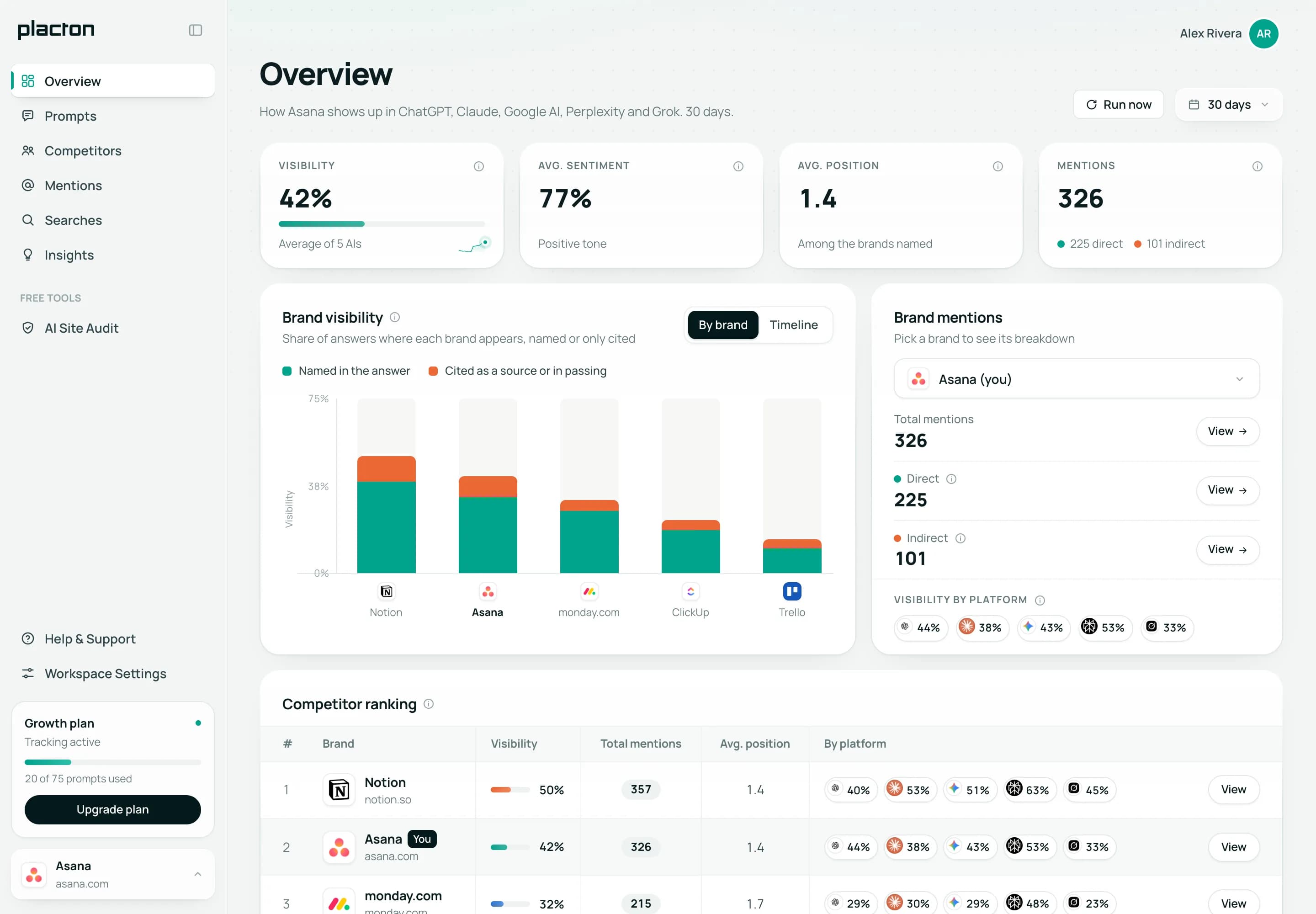
An AI answer is a short recommendation, not a post you can reply to. These are the six things worth watching in it.
Whether you are named, or only cited
A direct mention says your name; an indirect one links to your site without saying it. Both count toward your visibility, and the split shows whether AI knows your brand or only your pages.
How it talks about you
Every time an answer names you, the mention is marked positive, neutral or negative. Placton turns them into a tone index from 0 (always critical) to 100 (always positive), where 50 is neutral.
Where you sit in the list
AI answers usually list a handful of brands. Placton records your place each time you are named and averages it, so “mentioned fifth” never passes for “recommended first”.
What the answer relies on
The pages each answer cites, and whether each one is yours, a competitor’s or a third party’s. That is where a description of your brand comes from.
Who is named next to you
Up to 25 competitors you choose, measured in the same answers, plus the brands the AI keeps naming that you do not track yet.
What changed this week
A drop in visibility, a rival moving ahead or a new critical answer, summed up in one email a week on paid plans.
AI brand tracking: answers every day, one email a week
AI answers drift over days, not seconds, so Placton does not ping you every time one moves. Here is what it checks, how often, and what reaches your inbox.
- Every day*
- ChatGPT, read on chatgpt.com, and Google AI Overviews, read in real Google results.
- Every week
- Claude, Perplexity and Grok, asked with live web search turned on.
- Once a week, by email
- A summary of your numbers, your rivals and the tone of the answers. It opens with an alert when your visibility drops 10 points or more, a rival moves ahead of you or a new answer speaks badly of you.
- Whenever you want
- “Run now” checks your prompts again on demand, with no limit on paid plans.
Admins choose the full summary, alerts only or nothing for the workspace, and each person can turn it on or off for themselves. The email comes with the paid plans; during the trial you follow the answers in the dashboard. The exact thresholds behind each alert are on our AEO tracker page.
All five AI platforms on every plan.
* On paid plans. ChatGPT is read on chatgpt.com in every country Placton tracks except Venezuela and Puerto Rico, where it is asked weekly through its API.
See what AI can read on your website
We run 18 checks on what helps AI assistants find, read and cite your site, and tell you what to fix first.
Ready as soon as you sign up, included in the free trial.
No account? Free GEO audit tool: the same 18 checks, without signing up.
What to do when AI gets your brand wrong
No tool can edit what an AI writes. What you can change are the sources it reads. A four-step routine:
- 1
Read the whole answer
Open it in Searches: the full text, the brands it names in order and every page it cites, so you know exactly what was said and where.
- 2
Trace the claim to a source
Old pricing, a discontinued product or a harsh review usually traces back to one of the cited pages, or to something your own site never explains.
- 3
Fix it where it lives
Update your site with the facts in plain sentences (prices, features, coverage, contact), answer the review, or ask the directory or comparison page to correct its listing.
- 4
Watch the next weeks
On paid plans ChatGPT and Google AI are checked every day, so they show first whether anything moves; the weekly email tells you when your tone or visibility changes.
When the trouble is that AI names your rivals instead of you, rather than describing you badly, start with our AI competitor analysis page.
What the trial includes
Everything you need to see how AI describes your brand before you pay anything.
7 days free, no card. Sign up with your email or Google. When the trial ends, tracking stops and nothing is charged.
Up to 10 prompts. We suggest prompts and competitors from your website, and you edit the list before the first run.
All five AI platforms on day one. ChatGPT, Google AI Overviews, Claude, Perplexity and Grok answer your prompts as soon as your email is confirmed.
ChatGPT and Google AI again every day while you keep visiting your dashboard. Claude, Perplexity and Grok are asked once, at sign-up.
One “Run now” and the 18-point site audit. After the trial, our free GEO audit tool still audits any site, without an account.
On paid plans only: team invites and the weekly email summary with alerts.
* On paid plans. ChatGPT is read on chatgpt.com in every country Placton tracks except Venezuela and Puerto Rico, where it is asked weekly through its API.
Placton Starter
Track 20 prompts on 5 AI platforms
$59/ month (USD)
Or $602 billed yearly · save $106
Start your 7-day free trial7 days free. No card required.
- Up to 20 prompts, about 1,440 answers a month
- ChatGPT, Google AI Overviews, Claude, Perplexity, Grok
- ChatGPT and Google AI every day*, the other three every week
- Competitor ranking (up to 25 rivals) and every cited URL
- Weekly insights, plus an email summary with alerts
- 18-point AI-readiness site audit
- Up to 2 team members
Need more prompts? Growth is $129 a month for 75 and Scale $299 for 250. Compare all plans
When another tool fits better
Placton is not the right answer for everyone. Pick something else if:
You need alerts within minutes
Placton flags changes once a week, inside the summary email. There are no push, SMS or Slack alerts, so a mention that must reach you right away needs another tool.
You need social media and press
Placton reads AI answers only. Posts, reviews and news coverage belong to a social listening or media monitoring tool, and the two work well side by side.
You need Gemini, AI Mode or Copilot
None of the three is covered by Placton. HubSpot AEO (opens in a new tab) checks Gemini daily together with ChatGPT and Perplexity, and lists sentiment among its metrics (checked October 19, 2026).
You want AI traffic next to mentions
Placton does not measure visits. Profound (opens in a new tab) lists AI traffic among its metrics (checked October 19, 2026), and GA4 shows sessions from AI assistants for free.
You monitor one brand in many markets
Each Placton workspace covers one country and one language, so a brand in five markets means five workspaces, with no view that adds them up.
Questions about AI brand monitoring
About Placton itself? Read the full FAQs or see every plan and price.
What is AI brand monitoring?
Checking, on a schedule, what AI assistants such as ChatGPT write when people ask about your market or your brand: whether you are named, how you are described, which rivals appear next to you and which sources the answer relies on.
How is it different from social listening?
Social listening follows what people publish: posts, reviews and articles. AI brand monitoring follows the private answers an AI writes for each user, which you cannot see or reply to on the spot. You influence them through the sources the AI reads.
Is AI brand monitoring in real time?
Not in Placton. On paid plans ChatGPT and Google AI Overviews are checked every day and Claude, Perplexity and Grok every week, and alerts arrive in the weekly email. You can also check your prompts again at any time with “Run now”.
What counts as a mention?
A direct mention names your brand, or one of the other names you add for it. An indirect mention cites a page of your website without naming you. Both count toward your visibility, and the dashboard shows them apart.
How is the tone measured?
Each direct mention is marked positive, neutral or negative. The tone index turns them into a 0 to 100 scale (100 always positive, 50 neutral, 0 always critical) on each AI platform, and then averages the platforms with equal weight.
What triggers an alert?
A visibility drop of 10 points or more, a competitor moving ahead of you, or an answer that speaks badly of you where it did not the week before. Alerts open the weekly email rather than arriving on their own, and the email is not sent during the free trial.
What is an AI brand tracker, and what should AI brand monitoring tools include?
An AI brand tracker follows your brand in AI answers over time, so you see a trend instead of a single screenshot. Whatever the name, look for the answers people actually see, misses counted as zero, tone and position next to visibility, the sources behind each answer and your rivals measured in the same answers.
Can I monitor my competitors too?
Yes. Add up to 25 competitors and Placton measures them in the same answers and with the same metrics as your brand.
Can Placton correct what an AI says about me?
No tool can edit an AI’s answer. Placton shows you the answer, the sources behind it and a weekly idea on what to change; fixing those sources is what moves the answer over time.
Is there a free plan?
There is no free plan, but there is a 7-day trial without a card: up to 10 prompts, all five AI platforms on day one and the 18-point site audit. Starter costs $59 a month, and the audit alone is free at any time on our GEO audit tool page, without an account.
Find out how AI describes your brand
Add your website and read what ChatGPT, Google AI Overviews, Claude, Perplexity and Grok say about you, and about your competitors, on your first day.
7 days free. No card required.