


Skip to content

AI citation tracking

AI citation tracking records the pages AI assistants cite when they answer. A citation links to a page; a mention names a brand, and you can get one without the other. Placton logs every URL that ChatGPT, Google AI Overviews, Claude, Perplexity and Grok cite for your prompts, and shows which ones send the credit to your rivals.

Citations tracked onChatGPTClaudeGoogle AIPerplexityGrok

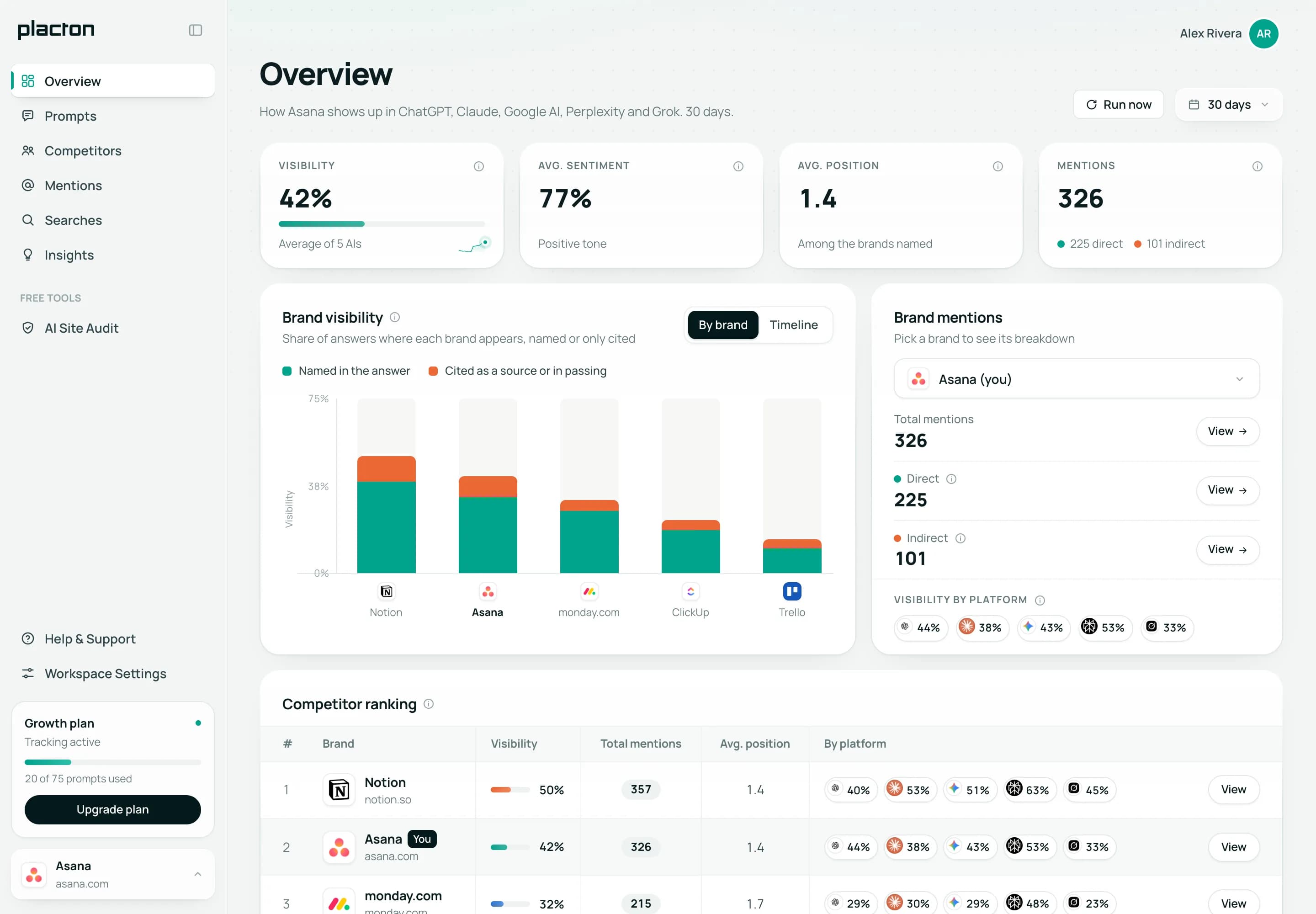
Placton dashboard: visibility, sentiment, average position and mentions, a chart of direct and indirect mentions by brand and the competitor ranking.

AI mentions vs citations: four outcomes in every answer

An answer can name your brand, cite your website, do both or do neither. Placton records which one happened in every answer, because each calls for a different move.

  • NamedCited

    Named and cited

    The best outcome: the AI recommends you and backs it with your own page. It counts as a direct mention, and the link is filed under your site in Sources.

  • NamedNot cited

    Named, not cited

    The AI knows you but describes you from other people’s pages, so they shape what it says. When no answer cites your domain all week, Placton raises the insight “You are mentioned, but your website is not the source”.

  • Not namedCited

    Cited, not named

    The AI uses your content without recommending you. Placton counts it as an indirect mention, so it still adds to your visibility, and marks the answer “Cited as a source”.

  • Not namedNot cited

    Neither

    The answer counts as zero in your visibility. Its sources still help: the pages the AI cited instead show where it found the brands it did recommend.

How these outcomes feed your visibility score, citation rate and source mix is explained in our guide to AI visibility metrics.

What an AI citation tracker records

Placton’s Sources view gathers every citation from your prompts in one list, so you can see which domains the five AI platforms lean on in your market.

  • The citation split. What share of all citations points to your site, to your competitors and to third parties. Each AI platform weighs the same, however often it answers.

  • Most cited domains. Ranked by the share of answers that cite each one, with its number of citations and the AI platforms that cite it.

  • Who owns each domain. Your site, or the name of the competitor whose website it is. Unlabeled domains are third parties: review sites, directories, forums and media.

  • The exact pages. Open a domain to see its most cited URLs, with their page titles and how many times each one was cited.

  • One AI or one period at a time. Filter by platform, and switch between the latest run, 7, 30 and 90 days.

  • The answer behind each link. Searches keeps every answer in full, with its cited sources and the web searches the AI ran before answering.

Sources in Placton: the citation split and the most cited domains, one of them opened (example data).

Turn AI citations into a to-do list

A list of domains only helps if it tells you where to act. Placton reads your citations every week and turns two patterns into insights, each with the number behind it.

Insight

You are mentioned, but your website is not the source

When it appears
Your brand appears in the week’s answers, yet no AI platform cites a page on your domain. The AI describes you from what others write, and you do not control that message.
What to do
Publish on your own domain what the AI takes from elsewhere today: comparisons, pricing, FAQs with the answer in the first sentence, and structured data (Organization, Service, FAQPage).
Based on
Your appearances that week, and zero citations to your domain.

Insight

Some sources recommend your competitors and not you

When it appears
Third-party pages are cited in answers that name a competitor and leave you out. Search engines, the AI companies’ own sites and YouTube are set aside, and each prompt counts once per AI platform.
What to do
Get onto those pages: a listing in the directory, a mention in the comparison article or a review. They are the shortest way into those answers.
Based on
Up to six domains, each with how many prompt and platform pairs cite it.
The insight as it reads on Placton’s Insights page (example data).

Three more insights that send you to Sources

  • Your visibility drops 10 points or more in a week. Check in Sources which domains gained weight, and in Mentions who took your spot.

  • A competitor shows up 15 points or more ahead of you. Open those answers and look at the sources the AI cites when it talks about them.

  • Your visibility on one AI platform trails your best one by 25 points or more. Filter Sources by that platform to see which pages it relies on.

On paid plans, the weekly email also counts the answers that cited your website against the week before, and warns you when your site stops being cited at all.

See what AI can read on your website

We run 18 checks on what helps AI assistants find, read and cite your site, and tell you what to fix first.

Ready as soon as you sign up, included in the free trial.

No account? Free GEO audit tool: the same 18 checks, without signing up.

How Placton tracks AI citations

The rules that decide what counts as a citation and whose it is, so the numbers in Sources mean the same thing every week.

  • Your brand stays out of the prompt. Each prompt goes in exactly as you wrote it, so a citation of your page is one the AI chose on its own.

  • One URL, one citation per answer. Every link is stored once per answer with its page title, and grouped under its main domain: blog.yourbrand.com counts as yourbrand.com.

  • Ownership comes from websites. A citation is yours when its domain matches your website, a competitor’s when it matches the website of one of the up to 25 rivals you track, and a third party’s otherwise.

  • Two rhythms. ChatGPT and Google AI Overviews are checked every day*; Claude, Perplexity and Grok every week, through their APIs with live web search on.

What counts as a citation on each AI

ChatGPT
The sources chatgpt.com shows with the answer, read logged out. If it shows none, the first pages it searched, up to 10.
Google AI Overviews
The links inside the AI Overview on the real Google results page. When Google shows no AI Overview, there is nothing to cite and the answer stays out of the averages.
Claude
The pages Claude cites in its answer. If it cites none, the first pages it read, up to 10.
Perplexity
The sources Perplexity returns with its answer.
Grok
The links Grok attaches to its answer.

* On paid plans. ChatGPT is read on chatgpt.com in every country Placton tracks except Venezuela and Puerto Rico, where it is asked weekly through its API.

What the trial includes

See which pages the five AI platforms cite for your own prompts before you pay anything.

  • 7 days free, no card. Sign up with your email or Google. When the trial ends, tracking stops and nothing is charged.

  • Up to 10 prompts. We suggest prompts and competitors from your website, and you edit the list before the first run.

  • All five AI platforms on day one. ChatGPT, Google AI Overviews, Claude, Perplexity and Grok answer your prompts as soon as your email is confirmed.

  • ChatGPT and Google AI again every day while you keep visiting your dashboard. Claude, Perplexity and Grok are asked once, at sign-up.

  • One “Run now” and the 18-point site audit. After the trial, our free GEO audit tool still audits any site, without an account.

  • On paid plans only: team invites and the weekly email summary with alerts.

* On paid plans. ChatGPT is read on chatgpt.com in every country Placton tracks except Venezuela and Puerto Rico, where it is asked weekly through its API.

Placton Starter

Track 20 prompts on 5 AI platforms

$59/ month (USD)

Or $602 billed yearly · save $106

Start your 7-day free trial

7 days free. No card required.

  • Up to 20 prompts, about 1,440 answers a month
  • ChatGPT, Google AI Overviews, Claude, Perplexity, Grok
  • ChatGPT and Google AI every day*, the other three every week
  • Competitor ranking (up to 25 rivals) and every cited URL
  • Weekly insights, plus an email summary with alerts
  • 18-point AI-readiness site audit
  • Up to 2 team members

Need more prompts? Growth is $129 a month for 75 and Scale $299 for 250. Compare all plans

When another tool fits better

Placton is not the answer to every citation question. Pick something else if one of these is a must. Vendor details as published on their own sites, checked on October 19, 2026 and October 24, 2026.

You need citations from Gemini, AI Mode or Copilot

Placton does not track them, so it cannot show their sources. Peec AI (opens in a new tab) lets you pick three of ChatGPT, AI Mode, AI Overviews, Microsoft Copilot, Gemini, Naver AI on its self-serve plans. For Copilot alone, Bing Webmaster Tools reports citations of your pages for free; see what the free reports cover.

You want Perplexity citations every day

Placton asks Perplexity, Claude and Grok once a week. Otterly.AI (opens in a new tab) Lite checks ChatGPT, AI Overviews, Perplexity and Copilot daily and reports citations, for $29 a month and 15 prompts; Claude is a paid add-on.

Your citation data has to leave the dashboard

Placton has no CSV export, API or integrations. Peec AI (opens in a new tab) offers custom CSV exports on every plan and an API from Pro, and Profound (opens in a new tab) Enterprise adds an API to its CSV and JSON exports.

You want the clicks or crawler visits behind citations

Placton reads the answers, not your traffic or server logs. GA4 counts sessions from AI assistants for free. Among paid tools, Profound (opens in a new tab) lists AI traffic in its metrics and Scrunch (opens in a new tab) lists AI bot traffic.

You compare citations across countries in one project

A Placton workspace measures one country and one language, so three markets mean three workspaces or the Agency plan. In Peec AI (opens in a new tab)’s plan table, Pro and Advanced cover 3 countries each.

Questions about AI citation tracking

About Placton itself? Read the full FAQs or see every plan and price.

What is AI citation tracking?

It means recording which web pages AI assistants link to as sources when they answer, and how often, over a fixed set of prompts. Followed week after week, it shows which domains each AI trusts in your market, whether your own pages are among them and which sources keep recommending your competitors.

What is the difference between an AI mention and an AI citation?

A mention is your brand name written in the answer. A citation is a link to a page shown as a source. They often come apart: an AI can name you while citing only review sites, or cite your page without naming you. Placton calls the second case an indirect mention and counts it toward your visibility.

Which AI platforms does Placton track citations on?

ChatGPT, Google AI Overviews, Claude, Perplexity and Grok, on every plan with no add-ons. Citations from Google AI Mode, the Gemini app, Microsoft Copilot or Meta AI are not tracked.

How often are AI citations checked?

Every day for ChatGPT and Google AI Overviews and every week for Claude, Perplexity and Grok, on paid plans. In Venezuela and Puerto Rico, chatgpt.com cannot be read, so Placton asks ChatGPT weekly through its API.

In the free trial, all five answer on day one; after that, ChatGPT and Google AI keep answering every day while you keep visiting your dashboard.

Does Placton track individual URLs or only domains?

Both. Sources ranks domains, and each domain opens into its most cited URLs with their page titles and how many times each was cited. Subdomains are grouped under their main domain, so blog.yourbrand.com counts as yourbrand.com.

Can I see which of my competitors’ pages AI cites?

Yes. Add each competitor with its website, up to 25 of them, and citations of its domain are filed under its name with the exact URLs. That shows which of their pages, such as comparisons, pricing or guides, the AI leans on.

Do AI citations send traffic, and can Placton measure it?

Placton does not measure visits, so it cannot say how many clicks a citation brings, and a citation is no promise of one. For visits, GA4 groups sessions from AI assistants for free, and Search Console counts AI Overview impressions. Placton covers what those reports miss: which pages the answers cite and which brands they recommend.

What the free reports cover

Why does AI cite my competitors’ pages and not mine?

Often because their pages answer the prompt more directly, or because the third-party pages the AI finds first list them and not you. Start with the domains in Sources that are not yours, make sure robots.txt lets AI crawlers such as GPTBot, ClaudeBot and PerplexityBot in (the free 18-point audit checks it) and publish pages that answer the question plainly. No tool can guarantee a citation.

Is there a free AI citation tracker?

Placton has a 7-day free trial with no card: up to 10 prompts, cited sources from all five AI platforms on day one and the 18-point site audit. Once the trial ends, tracking needs a paid plan, from $59 a month. For Copilot alone, Bing Webmaster Tools reports citations of your pages at no cost.

See every plan and price

Can I export my citation data?

No. Citations stay in the dashboard, each with its URL, its domain and the answer it came from; Placton has no export, API or integration to send them elsewhere.

What else Placton tracks

Find out which pages AI cites in your market

Add your website and your competitors, review the prompts we suggest, and read the sources behind your first answers from all five AI platforms on day one.

Start your 7-day free trial

7 days free. No card required.

Compare all plans