ChatGPT visibility tracker
A ChatGPT visibility tracker asks ChatGPT your customers’ questions on a schedule and records whether your brand is named or cited, in what position, next to which rivals and with which sources. Placton reads the answers on chatgpt.com, the way a logged-out person sees them, rather than an API reply.
7 days free. No card required.
Placton tracks ChatGPT
 Claude
 Google AI
 Perplexity
 Grok

Why a ChatGPT visibility tracker should read chatgpt.com, not the API
There are three ways to get an answer out of ChatGPT, and they do not agree. Only one of them is what a new customer sees.
What Placton reads
chatgpt.com, logged out
The answer a first-time visitor gets: no account, no memory, no custom instructions. Placton asks with web search on, in the country and language of your workspace, so you see the pages ChatGPT relies on. You and every rival are measured on the same baseline.
Fallback only
The ChatGPT API
The model without the ChatGPT app around it. Whoever calls it picks the model version, the instructions and whether it searches the web, so its answers can name other brands, in another order. Placton uses it only where chatgpt.com cannot be read.
Not a measurement
Your own ChatGPT account
Memory, custom instructions and past chats can steer the answer toward what you already talk about. It is a fine gut check, but your buyers do not share your history, so it says little about what they see.
Every prompt, every day.* On paid plans, Placton asks each of your prompts on chatgpt.com once a day and keeps the full answer, so your trend is built from daily answers rather than an occasional snapshot.
Labelled at source. Each ChatGPT answer in your dashboard says whether it came from chatgpt.com or the API, and a score never mixes the two in the same period.
* On paid plans. ChatGPT is read on chatgpt.com in every country Placton tracks except Venezuela and Puerto Rico, where it is asked weekly through its API.
ChatGPT brand mentions: what each answer records
Every ChatGPT answer is stored in full and broken down the same way. Here is one answer as Placton shows it, with example data.
Direct mention and position
ChatGPT named Asana second. Position is the order in which an answer names brands, and Placton averages yours across every answer that names you.
Indirect mention
ClickUp is never named, but one of its pages is cited as a source. That still counts toward its visibility, because ChatGPT drew on its content.
Tone
Every brand named is marked positive, neutral or negative. The bar is strict: positive needs a clear recommendation or praise, negative an explicit drawback.
Cited sources
Every link shown with the answer. Across all your prompts, Sources ranks the domains ChatGPT leans on and marks each one as yours, a competitor’s or a third party’s. More on AI citation tracking.
Searches ChatGPT ran
The web searches ChatGPT made before it wrote the answer, often called fan-out queries. They show which searches your pages need to win.
ChatGPT rank tracker: who gets named before you
ChatGPT has no fixed list of ten results. Every answer is written fresh, so rank means how often you are named and how early, against the same rivals over time.
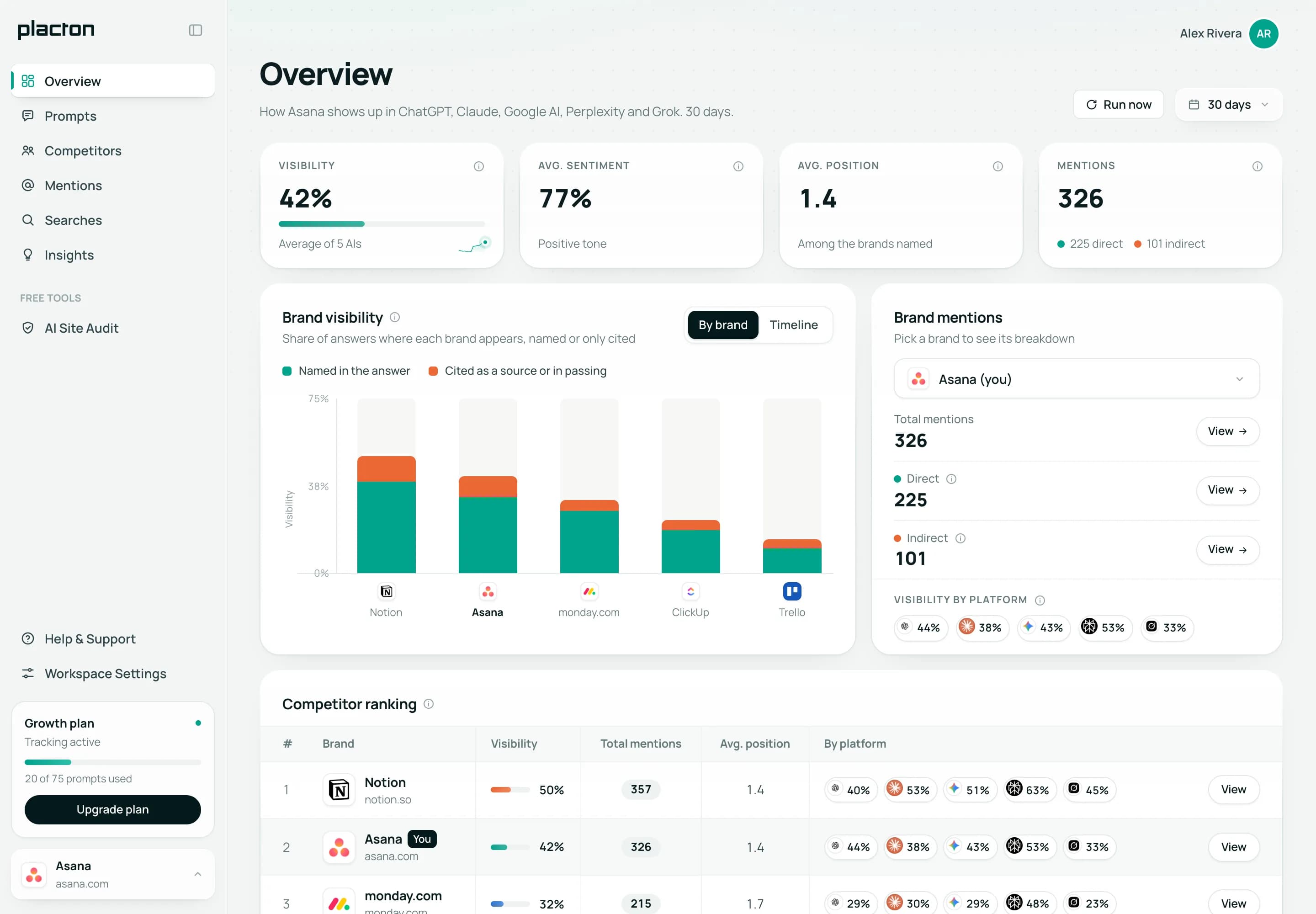
Average position. The order in which ChatGPT names brands, averaged over every answer that names you, next to the same figure for each rival.
Rivals on the same prompts. Up to 25 competitors, each with its visibility on ChatGPT and on every other AI platform, so you see who ChatGPT favors and where.
ChatGPT on its own. Filter Mentions, Sources and Searches by ChatGPT to read only its answers.
A flag when ChatGPT lags. If ChatGPT is your weakest AI platform, 25 points or more behind your strongest, your weekly insights say so and point you to the sources ChatGPT uses.
Alerts by email. On paid plans, the weekly email flags a drop of 10 points or more in your overall visibility, a rival that overtakes you and new negative answers. Not in real time, and not during the trial.
See what AI can read on your website
We run 18 checks on what helps AI assistants find, read and cite your site, and tell you what to fix first.
Ready as soon as you sign up, included in the free trial.
No account? Free GEO audit tool: the same 18 checks, without signing up.
How to check your ChatGPT visibility by hand
A private browser window is enough for a first, free read. These five steps keep the check fair, and the card next to them shows where it stops being enough.
Write five buyer questions.
Use the words of someone who has never heard of you: the category, the need and, for a local business, the place. “Best payroll software for a 15-person agency” tells you something; “Is Acme Payroll any good?” does not.
Open a private window and stay logged out.
Your account can draw on memory, custom instructions and past chats. Logged out, you get closer to what a new buyer sees.
Ask each question in a new chat.
Write down every brand ChatGPT names, in order, how it describes you and which links it shows as sources.
Ask again on other days.
ChatGPT writes every answer fresh, so the brands and their order shift from one run to the next. Three runs per question, on different days, is a sensible minimum.
Count, don’t eyeball.
Your visibility is the share of answers that name or cite you. Named in 4 of 15 answers is 27%, however good the best answer looked.
Where a hand check stops being enough
Volume. Five questions asked three times give you 15 answers. Placton Starter collects about 600 ChatGPT answers a month*, and our guide shows how many answers a real change needs.
Your market, not your desk. A private window still answers for where you sit. Placton asks in the country and language of your workspace, from 40 countries and 7 languages.
Every rival and source at once. By hand you read one answer at a time. Placton adds up every brand named and every domain cited across all your prompts, with up to 25 competitors.
History. Every answer is kept in full, with 7, 30 and 90-day views, so you can tell whether a change lasted.
* On paid plans. ChatGPT is read on chatgpt.com in every country Placton tracks except Venezuela and Puerto Rico, where it is asked weekly through its API.
Also included: four more AI platforms
Your buyers do not all ask ChatGPT. Every plan also tracks Google AI Overviews, Claude, Perplexity and Grok at no extra cost, and you can read each one on its own.
- Google AI OverviewsEvery day*
- ClaudeEvery week
- PerplexityEvery week
- GrokEvery week
Only care about ChatGPT? Switch the others off in your workspace settings; the price stays the same. For the bigger picture, see how our AI visibility tool measures all five, or read about tracking Google AI Overviews.
* On paid plans. ChatGPT is read on chatgpt.com in every country Placton tracks except Venezuela and Puerto Rico, where it is asked weekly through its API.
What the trial includes
Judge Placton on your own ChatGPT answers before you pay anything.
7 days free, no card. Sign up with your email or Google. When the trial ends, tracking stops and nothing is charged.
Up to 10 prompts. We suggest prompts and competitors from your website, and you edit the list before the first run.
All five AI platforms on day one. ChatGPT, Google AI Overviews, Claude, Perplexity and Grok answer your prompts as soon as your email is confirmed.
ChatGPT and Google AI again every day while you keep visiting your dashboard. Claude, Perplexity and Grok are asked once, at sign-up.
One “Run now” and the 18-point site audit. After the trial, our free GEO audit tool still audits any site, without an account.
On paid plans only: team invites and the weekly email summary with alerts.
* On paid plans. ChatGPT is read on chatgpt.com in every country Placton tracks except Venezuela and Puerto Rico, where it is asked weekly through its API.
Placton Starter
Track 20 prompts on 5 AI platforms
$59/ month (USD)
Or $602 billed yearly · save $106
Start your 7-day free trial7 days free. No card required.
- Up to 20 prompts, about 1,440 answers a month
- ChatGPT, Google AI Overviews, Claude, Perplexity, Grok
- ChatGPT and Google AI every day*, the other three every week
- Competitor ranking (up to 25 rivals) and every cited URL
- Weekly insights, plus an email summary with alerts
- 18-point AI-readiness site audit
- Up to 2 team members
Need more prompts? Growth is $129 a month for 75 and Scale $299 for 250. Compare all plans
When another tool fits better
Placton is not the right answer for everyone. Pick something else if one of these matters more to you. Rival details come from each vendor’s own pages, checked on October 19, 2026 and October 24, 2026; for prices side by side, see our GEO tools under $100 comparison.
You want ChatGPT checked more than once a day
Placton reads ChatGPT once a day on paid plans. Rankscale (opens in a new tab) Pro ($99 a month, 1,200 credits, up to 4,800 AI answers) lets you set any refresh rate from hourly to monthly.
You need many daily prompts on a small budget
SE Visible (opens in a new tab) Basic tracks 200 prompts daily for $99 a month and says it reads every answer through the browser interface, not an API.
You also need Google AI Mode, Gemini or Copilot
Placton does not track them. Otterly.AI (opens in a new tab) Lite covers ChatGPT, AI Overviews, Perplexity and Copilot, with AI Mode and Gemini as add-ons; Peec AI (opens in a new tab) lets you pick three of ChatGPT, AI Mode, AI Overviews, Copilot, Gemini and Naver.
You need ChatGPT Shopping
Placton reads ChatGPT’s written answer and the sources behind it; it has no shopping or product report. Profound (opens in a new tab) lists ChatGPT Shopping on its Enterprise plan, which has custom pricing and a “Get a Demo” button instead of a public price.
You need exports, an API or Looker Studio
Placton has no data exports, API or integrations. Peec AI (opens in a new tab) includes CSV exports on every plan, an API from Pro and a Looker Studio integration on Advanced.
You want the traffic ChatGPT sends you
Placton measures what ChatGPT says, not the visits it sends. GA4 shows sessions from ChatGPT for free; see what the free reports cover.
Questions about tracking ChatGPT
About Placton itself? Read the full FAQs or see every plan and price.
What is a ChatGPT visibility tracker?
A tool that asks ChatGPT a fixed set of buyer questions on a schedule, stores every answer and reports how often your brand is named or cited, in what position, with what tone and next to which competitors. It has to repeat the questions because ChatGPT writes each answer fresh and the brands it names change from run to run.
How do I track brand mentions in ChatGPT?
Choose the questions buyers ask before they know your name, leave your brand out of them and ask each one several times, logged out, noting who is named, in what order and with which sources. That works for a first look at a few dozen answers.
To follow it week after week, use a tracker. On paid plans, Placton asks every prompt on chatgpt.com every day (weekly through the API in Venezuela and Puerto Rico) and keeps every answer in full.
Does Placton use the ChatGPT API?
Only where chatgpt.com cannot be read. Placton reads the answer a logged-out person sees on chatgpt.com, with web search on, in your workspace’s country and language. In Venezuela and Puerto Rico it asks ChatGPT weekly through its API instead, and every answer in your dashboard is labelled chatgpt.com or API.
How often does Placton check ChatGPT?
Every day on paid plans, for every prompt (weekly through the API in Venezuela and Puerto Rico). In the 7-day free trial, ChatGPT answers on the day you sign up and again every day while you keep visiting your dashboard. Alerts arrive in the weekly email, not in real time.
Why does my own ChatGPT give different answers?
When you are logged in, ChatGPT can draw on your memory, custom instructions and past chats, and every run varies a little anyway. Placton uses a logged-out session so your brand and your rivals are measured the same way, and it judges the trend over many answers rather than any single one.
Does ChatGPT rank brands like Google ranks pages?
Not in a fixed list. Each answer is written for the question, so the brands named and their order change. A ChatGPT rank tracker records that order in every answer and averages your position when you are named, next to each competitor’s, alongside how often you are named at all.
Can I track only ChatGPT?
Yes. You can switch the other AI platforms off in your workspace settings, but every plan includes all five at the same price, so turning them off saves nothing. The weekly drop and overtake alerts also need at least three AI platforms to compare. Most people keep all five on and filter Mentions, Sources and Searches by ChatGPT.
Which countries and languages can I track ChatGPT in?
Any of Placton’s 40 countries, in English, Spanish, French, German, Italian, Portuguese or Catalan (7 languages). chatgpt.com is read in all of them except Venezuela and Puerto Rico, where ChatGPT is asked weekly through its API. Each workspace covers one country and one language.
Can I try it for free?
Yes, with a 7-day free trial and no card: up to 10 prompts, and answers from ChatGPT and the other four AI platforms on day one. There is no free plan, but the 18-point site audit is free on our GEO audit tool page, with no account needed. Paid plans start at $59 a month.
Does Placton show how much traffic ChatGPT sends me?
No. Visits that arrive from chatgpt.com show up in GA4 for free. Placton covers what GA4 cannot see: what ChatGPT says about you, including in the answers that never lead to a click.
How do I get ChatGPT to mention my brand more?
Start from the sources ChatGPT cites for your prompts: third-party pages that list your rivals and not you are the shortest way in, and your own pages should answer the question plainly. Make sure robots.txt lets OpenAI’s crawlers in (GPTBot, OAI-SearchBot and ChatGPT-User); the free 18-point audit checks it. No tool can guarantee a mention.
See what ChatGPT says about your brand
Tell us your website and we suggest the prompts and rivals to track. Your first ChatGPT answers arrive on day one, as soon as you confirm your email.
7 days free. No card required.