AI competitor analysis: who AI recommends instead of you
AI competitor analysis compares how often AI assistants recommend you and your rivals when customers ask about your market, in what position and from which sources. Placton ranks you against up to 25 competitors on five AI platforms, shows each AI separately and flags brands the AI recommends that you are not tracking yet.
7 days free. No card required.
Placton tracks ChatGPT
 Claude
 Google AI
 Perplexity
 Grok

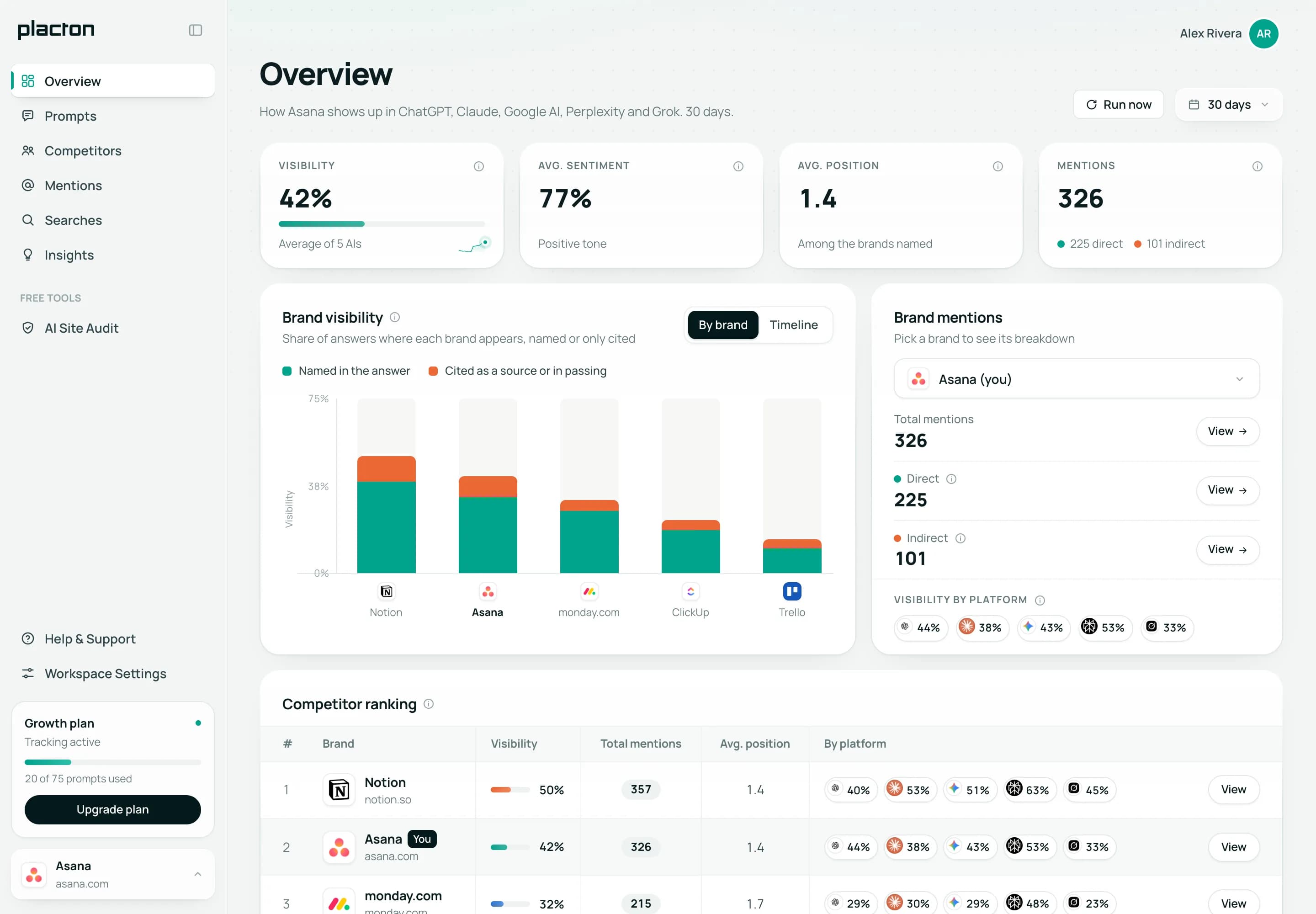
What an AI competitor analysis tool shows you
A ranking tells you who is ahead. These six figures tell you why, all measured in the same answers for you and every rival.
The gap, in points. Each rival’s visibility next to yours, with the difference spelled out. “+5 pts above you” is a target you can plan around.
Each AI on its own. Visibility per platform for every brand, because a rival can own ChatGPT while you lead on Perplexity.
Average position. Where each brand sits when it is named. A rival named less often but always first can still be the one buyers remember.
Mentions. Direct and indirect mentions for every brand in the period, counted in the same answers as yours.
Whose site gets cited. The share of answers that cite each brand’s own website: a sign of whose pages the AI trusts.
Rivals you had not listed. Brands that keep turning up in your answers without being on your list, ready to add with one click.
How to read an AI competitor ranking
Your place in the ranking is the average of five different races. The same five brands, asked the same prompts, line up in a different order on each AI platform.
Scroll sideways to see every column.
| Brand | ChatGPT | Claude | Google AI | Perplexity | Grok | Average |
|---|---|---|---|---|---|---|
| Notion | 62% (leads on this platform) | 47% (leads on this platform) | 44% (leads on this platform) | 38% | 39% | 46% |
| AsanaYou | 37% | 28% | 41% | 54% (leads on this platform) | 44% (leads on this platform) | 41% |
| monday.com | 30% | 22% | 27% | 31% | 25% | 27% |
| ClickUp | 22% | 15% | 18% | 21% | 19% | 19% |
| Trello | 12% | 8% | 10% | 14% | 11% | 11% |
Example data. A dot marks the brand that appears most on each platform. Each platform weighs the same in the average.
What this example says
Overall, Notion is first and Asana second, 5 points behind. But Asana leads on Perplexity and Grok, and the whole gap comes from the other three, above all ChatGPT, where Notion appears in 62% of answers and Asana in 37%. The work is on ChatGPT’s sources, not on everything at once.
It changes by AI because the sources change
Each assistant writes from different pages. ChatGPT searches the web from chatgpt.com, Perplexity uses its own search engine, Claude and Grok use a web search tool that Placton connects, and Google AI Overviews come from Google results. Being strong on one says little about the next.
It changes by prompt because intent changes
“Best tool for a small team” and “enterprise project software” have different winners. Before you decide where to compete, check in Mentions and Searches which prompts each rival wins.
Visibility and position tell different stories
A brand can be named often but low in the list, or rarely but first. Read both before you call a rival “ahead”, and watch the position when the gap in visibility is small.
Daily and weekly AIs need different patience
On paid plans each prompt gets about 30 answers a month on ChatGPT and Google AI and about 4 on Claude, Perplexity and Grok. A swing on a weekly platform needs a few weeks before it means much.
ChatGPT competitor analysis
ChatGPT is where many buyers start, so it deserves its own read. On paid plans Placton checks it every day on chatgpt.com, logged out and with web search on.*
See its column alone. Every brand’s ChatGPT visibility sits next to the other four platforms, so a rival that owns ChatGPT stands out at once.
Read the order. Each ChatGPT answer lists the brands it names, first to last, with the pages it cited.
Follow its searches. Placton keeps the web searches the AI ran before it answered, which tells you what ChatGPT went looking for when it picked your rivals.
For everything ChatGPT says about your own brand, see our ChatGPT visibility tracker page.
* On paid plans. ChatGPT is read on chatgpt.com in every country Placton tracks except Venezuela and Puerto Rico, where it is asked weekly through its API.
See what AI can read on your website
We run 18 checks on what helps AI assistants find, read and cite your site, and tell you what to fix first.
Ready as soon as you sign up, included in the free trial.
No account? Free GEO audit tool: the same 18 checks, without signing up.
Turn the competitor gap into a plan
Every week Placton reads the numbers and writes the ideas that apply to you, each with the figure behind it. Three of these four are about rivals; the fourth points to the AI platform that leaves you out.
A rival far ahead. When a competitor’s visibility is 15 points or more above yours, the idea names it, quotes a prompt where it shows up and you do not, and sends you to the sources the AI cites for it.
Sources that back your rivals. The third-party pages AI relies on when it names your competitors and not you: the listings, reviews and comparisons worth getting into first.
A platform that leaves you out. When your visibility on one AI is 25 points or more below your best platform, it gets its own idea, so you can see which sources that platform prefers.
Brands you are not tracking. Brands the AI names in at least two different answers, which you can add to your list and compare against straight away.
On paid plans the weekly email also warns you when a competitor overtakes you. The ideas point the way; the listings, pages and reviews are work you or your team still do.
How to choose a competitor analysis tool for AI search optimization
Lists of the best rated competitor analysis tools for AI search optimization rarely show ratings you can verify. We make Placton and do not publish star ratings; these are the questions that separate the tools, with our own answers.
Do you choose the competitors?
Placton suggests them from your website, and you keep, add or remove them, up to 25.
Are rivals measured in the same answers as you?
Yes. Every competitor is read in the same answers to the same prompts, so the gap compares like with like.
Can you see each AI separately?
Yes. Every brand has its visibility on each platform next to the overall figure, not only a blended score.
Can you open the answers behind a rival’s score?
Yes. Every answer is stored in full, with the brands it names in order and the pages it cites.
Does it find rivals you missed?
Brands that keep appearing in your answers are suggested, with the number of answers they appear in.
Which AI platforms are compared?
ChatGPT, Google AI Overviews, Claude, Perplexity and Grok. Not Gemini, Google AI Mode or Copilot.
What the trial includes
Everything you need to compare yourself with your rivals before you pay anything.
7 days free, no card. Sign up with your email or Google. When the trial ends, tracking stops and nothing is charged.
Up to 10 prompts. We suggest prompts and competitors from your website, and you edit the list before the first run.
All five AI platforms on day one. ChatGPT, Google AI Overviews, Claude, Perplexity and Grok answer your prompts as soon as your email is confirmed.
ChatGPT and Google AI again every day while you keep visiting your dashboard. Claude, Perplexity and Grok are asked once, at sign-up.
One “Run now” and the 18-point site audit. After the trial, our free GEO audit tool still audits any site, without an account.
On paid plans only: team invites and the weekly email summary with alerts.
* On paid plans. ChatGPT is read on chatgpt.com in every country Placton tracks except Venezuela and Puerto Rico, where it is asked weekly through its API.
Placton Starter
Track 20 prompts on 5 AI platforms
$59/ month (USD)
Or $602 billed yearly · save $106
Start your 7-day free trial7 days free. No card required.
- Up to 20 prompts, about 1,440 answers a month
- ChatGPT, Google AI Overviews, Claude, Perplexity, Grok
- ChatGPT and Google AI every day*, the other three every week
- Competitor ranking (up to 25 rivals) and every cited URL
- Weekly insights, plus an email summary with alerts
- 18-point AI-readiness site audit
- Up to 2 team members
Need more prompts? Growth is $129 a month for 75 and Scale $299 for 250. Compare all plans
When another tool fits better
Placton is not the right answer for everyone. Pick something else if one of these matters most. Rival details come from each vendor’s website, checked on October 19, 2026 and October 24, 2026.
You want a ready-made market database
Placton measures the prompts you choose. Ahrefs Brand Radar (opens in a new tab) also has a built-in prompt set, reports share of voice and estimated impressions for competitors, and is included with paid Ahrefs plans.
You need a share of voice figure
Placton ranks brands by visibility and position, with no share of voice number. LLMrefs (opens in a new tab) lists share of voice and position among its metrics.
You compare more than 25 rivals, or need them in a spreadsheet
Placton tracks up to 25 competitors and has no exports. Peec AI (opens in a new tab)’s Starter plan ($95/mo) lists unlimited competitors and custom CSV exports.
Your rivals win on Gemini or AI Mode
Placton does not track either. Semrush AI Visibility (opens in a new tab) compares competitors on ChatGPT, Google AI Mode and Gemini.
You compare rivals across countries
Each Placton workspace measures one country and one language, so a ranking in three markets means three workspaces, read one at a time.
Questions about AI competitor analysis
About Placton itself? Read the full FAQs or see every plan and price.
What is AI competitor analysis?
Measuring how AI assistants treat you and your competitors on the same questions: who gets named, how often, in what order and on which sources. It shows who AI recommends instead of you, and gives you the evidence to work out why.
What is the best platform for AI search optimization competitor analysis?
The one that measures your rivals in the same answers as you, on the AI platforms your buyers use, and lets you open those answers. We make Placton, so weigh our view accordingly: it covers five AI platforms, up to 25 rivals and every answer in full, but not Gemini, AI Mode or Copilot.
How many competitors can I track?
Up to 25 per workspace. During setup Placton suggests competitors from your website, and later it suggests brands that keep appearing in your answers.
Can I run a ChatGPT competitor analysis on its own?
Yes. Every plan includes all five AI platforms, and each brand’s ChatGPT visibility is shown separately from the others. On paid plans ChatGPT is checked every day on chatgpt.com, except in Venezuela and Puerto Rico, where it is asked weekly through its API.
Why is my rank different on each AI?
Each AI builds its answer from different sources and search tools, so the same rivals can line up in a different order on each one. Read each platform on its own before you act on the average.
Can I see which sources recommend my competitors?
Yes. Every cited page is stored with its owner, and a weekly idea lists the third-party pages AI relies on when it names your rivals and not you.
Can I analyze competitors for several clients?
Yes. On the Agency plan each client has its own workspace with its own list of up to 25 competitors.
Can I try it before paying?
Yes, for 7 days without a card, with up to 10 prompts, the competitors Placton suggests and all five AI platforms on day one. Paid plans start at $59 a month.
See who AI recommends instead of you
Add your website, keep the competitors we suggest and compare yourself with them on five AI platforms from your first day.
7 days free. No card required.