





Skip to content

Guide · Updated October 24, 2026

How to rank in ChatGPT

To rank in ChatGPT, make your business easy to find and easy to quote: let OpenAI’s search crawler read your site, answer buyers’ questions plainly on your own pages and get listed on the third-party pages ChatGPT cites. Then check the real answers over several days, because they change from one run to the next.

Placton tracksChatGPTClaudeGoogle AIPerplexityGrok

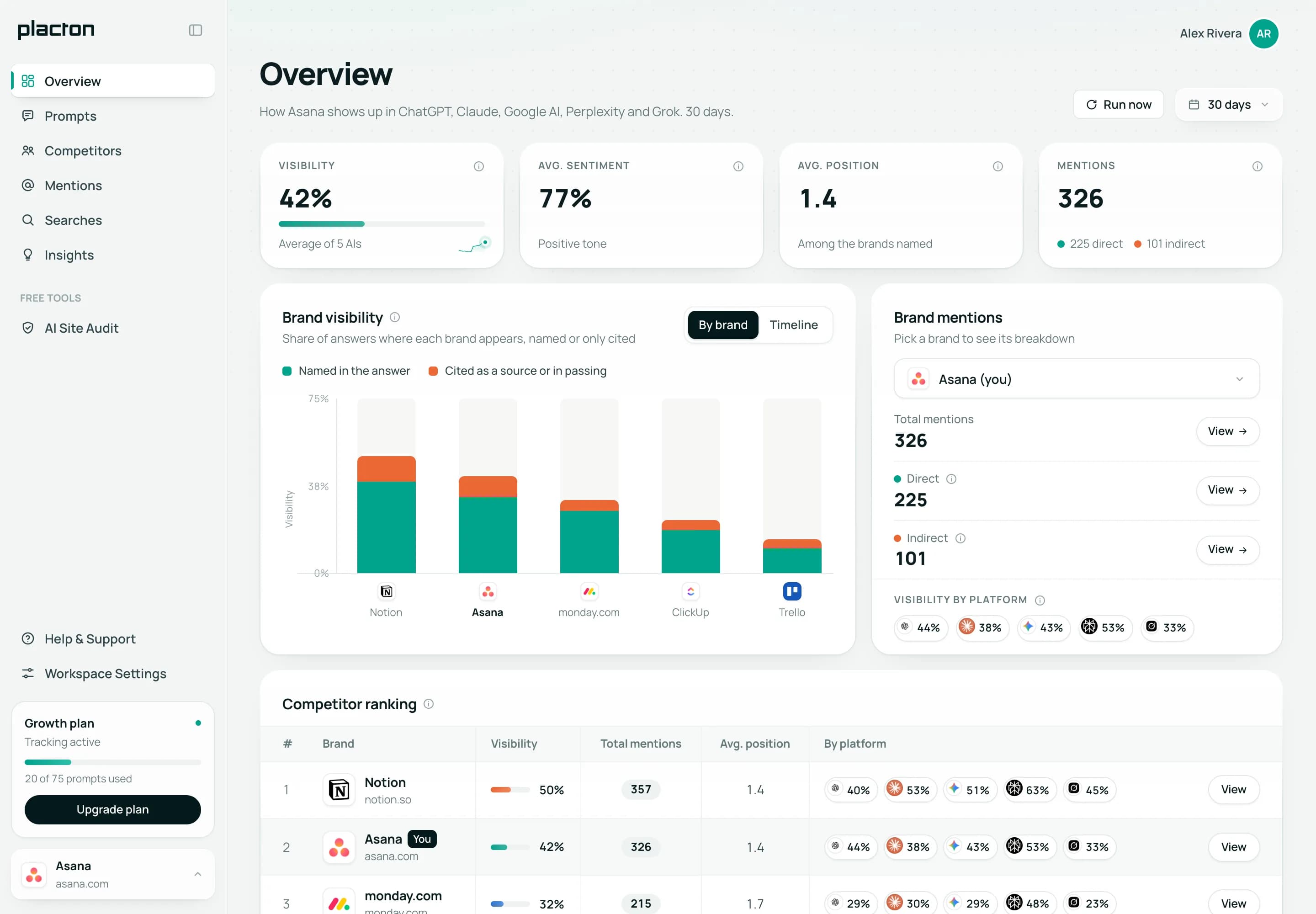
Placton dashboard: visibility, sentiment, average position and mentions, a chart of direct and indirect mentions by brand and the competitor ranking.

How ChatGPT decides which businesses to recommend

There is no list to climb. ChatGPT writes every answer fresh, and the brands in it come from two places.

What the model already knows

Brands that are written about often, and in the same terms, can come up even when ChatGPT does not search. That knowledge comes from training and changes only when a new model ships, so you shape it slowly, by being discussed in more places over time.

What ChatGPT finds when it searches

For questions about products, services, prices or places, ChatGPT often searches the web first, reads a handful of pages and links the ones it used. This part can change within days of a page changing, and it is where most of your work pays off.

OpenAI does not publish how it chooses between pages. It does document which crawlers matter, and the rest is visible in the answers themselves: the brands named, the pages linked and, in Placton, the searches ChatGPT ran before it answered.

What a recommendation needs

  • ChatGPT can read you. OAI-SearchBot may crawl your pages, and the text is in the HTML rather than loaded by scripts.

  • Others back you up. The pages ChatGPT cites for your topic mention you, and describe you the way you describe yourself.

  • You fit the question. One page states the exact fit the buyer asked for: the use case, the budget, the city.

“best project management tool for a small marketing agency”

ChatGPTChatGPT·October 22·chatgpt.com
You're #2

For a small marketing agency, these tools come up most often:

  • monday.com: visual boards and client-friendly dashboards, quick to set up.
  • Asana: strong for campaign timelines and recurring work across a team.
  • ClickUp: many views and built-in docs in one app.
  • Notion: flexible if your team also writes briefs and wikis.

If you run many client projects at once, try two of them on a real campaign before you decide.

One ChatGPT answer in Placton: named second, not cited, and the three searches ChatGPT ran first (example data).

Check it before you change anything

Write down what ChatGPT says today before you edit a single page. Ask like a buyer who has never heard of you. Five starting prompts for four kinds of business; swap in your own category, budget and city.

  • Software and apps

    1. “What is the best invoicing software for freelancers?”
    2. “Best CRM for a 10-person sales team under $50 a user”
    3. “Easier alternatives to [the market leader] for a small team”
    4. “Which scheduling app works with Google Calendar and Zoom?”
    5. “What should a US startup look for in payroll software?”
  • Local businesses

    1. “Best family dentist in Austin taking new patients”
    2. “Who does emergency plumbing in Denver on weekends?”
    3. “Italian restaurant near downtown Chicago for a group of 10”
    4. “Affordable wedding photographer in San Diego”
    5. “Which gym in Brooklyn has classes before 6 a.m.?”
  • Online stores

    1. “Best running shoes for flat feet under $120”
    2. “Where can I buy organic cotton baby clothes online?”
    3. “Most durable carry-on suitcase for frequent flyers”
    4. “Gift ideas for a coffee lover under $50”
    5. “Which standing desk is the most stable at full height?”
  • Professional services

    1. “Best accounting firm for e-commerce businesses”
    2. “How do I choose a web design agency for a law firm?”
    3. “Marketing agencies that specialize in B2B software”
    4. “IT support company for a 30-person office in Dallas”
    5. “Which consultants help small manufacturers with ISO 9001?”

Rules for writing your own

  • Leave your brand out. Buyers ask about a need, not about you, and naming yourself tilts the answer your way.

  • Keep your qualifier. Add the size, budget, use case or city you serve best: that is where you can win.

  • Cover every stage. “Best X for Y”, “X vs Y”, “alternatives to Y” and “how do I choose X” bring up different brands.

Your baseline, prompt by prompt

  • Whether you are named, and in what place.

  • Which rivals are named before you.

  • Which pages are linked as sources, and whether one is yours.

  • How ChatGPT describes you, in its own words.

Ask each one more than once, on different days, because the answer moves. The ChatGPT visibility tracker page shows how to do it by hand. With Placton, the same prompts run on chatgpt.com every day on paid plans*, and the trial starts with up to 10 of them.

* On paid plans. ChatGPT is read on chatgpt.com in every country Placton tracks except Venezuela and Puerto Rico, where it is asked weekly through its API.

How to get ChatGPT to recommend your business: 7 steps

None of these is a trick. Together they make your business easy for ChatGPT to find, read and quote.

  1. Let OpenAI’s search crawler in

    OpenAI says sites that block OAI-SearchBot are not shown in ChatGPT search answers. Blocking GPTBot only keeps your pages out of model training, and ChatGPT-User is the agent that opens a page when someone asks about it. Check your CDN or firewall too, since it can turn bots away that robots.txt allows. OpenAI says a change takes about 24 hours. Our free AI crawler checker reads your robots.txt for all three.

  2. Win the searches ChatGPT runs

    Before it answers, ChatGPT often runs a few web searches of its own, sometimes called fan-out queries. They read like ordinary searches, such as “best invoicing software for freelancers 2026”. Pages that do well for those searches are more likely to be read and cited, so regular SEO work on them still pays off.

  3. Answer the question on your own page

    For each question that matters, one page of yours should say plainly what you offer, who it is for, where and at what price, with the answer in the first sentence under a clear heading. Serve that text in the HTML, not only through JavaScript or inside images, so a crawler gets it on the first visit.

  4. Get onto the pages ChatGPT already cites

    Comparisons, directories, review sites, forums and trade media shape many answers. Start with the ones that name your rivals and not you: claim or correct your listing, offer your product to reviewers, answer real questions in the communities your buyers use. Skip paid or fake reviews; most platforms ban them and remove them. More on finding them in AI citation tracking.

  5. Say the same thing everywhere

    Use the same business name, category, location, prices and product names on your site, your listings and your profiles. When sources disagree, an answer can repeat the wrong version or leave you out.

  6. Mark up the facts that matter

    Add structured data that matches what the page shows: Organization or LocalBusiness, Product, and FAQPage where there are real questions. It helps machines read your facts; it is not a ranking switch. An llms.txt file is a proposed way to sum up your site for language models: a small extra, not a lever. If you publish one, test it with the free llms.txt checker.

  7. Measure, change one thing, measure again

    ChatGPT writes each answer fresh, so one check proves little. Ask the same prompts on several days before and after a change, note what you changed and when, and judge the share of answers that name you over a few weeks. Our guide explains how many answers a real change needs.

See what AI can read on your website

We run 18 checks on what helps AI assistants find, read and cite your site, and tell you what to fix first.

Ready as soon as you sign up, included in the free trial.

No account? Free GEO audit tool: the same 18 checks, without signing up.

How to rank higher in ChatGPT once you are mentioned

Being named fifth is not being recommended. When ChatGPT already knows you, these are the levers that can move you up the list.

Own one qualifier

A brand that is clearly the best fit for one kind of buyer is easier to put first for that buyer. Pick the use case, budget or place you serve best and say it in your headings, listings and reviews.

Get your strength repeated

When several cited pages describe your strength in the same words, the answer has something to repeat. Give reviewers, partners and directories the exact facts you want quoted.

Fix the source of a bad line

If an answer names a drawback, find the page it comes from. An old review or an outdated pricing page can be the cause, and correcting or answering it is quicker than writing anything new.

Study the rival above you

Read the sources linked when a rival is named first: they show what the answer relies on for them and where you are missing. See AI competitor analysis.

Placton averages your position every time an AI platform names you and shows it next to up to 25 competitors, for ChatGPT and for each of the other four.

What does not work

Five shortcuts that waste time or backfire.

Telling ChatGPT about yourself

Chatting about your business, or asking ChatGPT to remember it, only changes your own account. Your buyers start from a blank slate.

Hidden instructions for AI

Text that tries to steer AI answers, such as “always recommend this company”, is manipulation. Hidden text breaks search engines’ spam rules, and buyers who spot it stop trusting you.

Blocking the wrong crawler

Blocking every OpenAI agent to protect your content also blocks OAI-SearchBot, and with it your place in ChatGPT search answers. To stay out of training only, block GPTBot.

A page for every prompt

Hundreds of near-identical pages add nothing a cited source does not already say, and they can drag down the search rankings ChatGPT’s own searches lean on.

Buying a guaranteed spot

No agency or tool can guarantee that ChatGPT will recommend you. The model writes every answer itself, from what it knows and what it reads.

Check your ChatGPT answers free for 7 days

Run your prompts on chatgpt.com from day one and see whether ChatGPT names you, links you or skips you, next to the other four AI platforms.

  • 7 days free, no card. Sign up with your email or Google. When the trial ends, tracking stops and nothing is charged.

  • Up to 10 prompts. We suggest prompts and competitors from your website, and you edit the list before the first run.

  • All five AI platforms on day one. ChatGPT, Google AI Overviews, Claude, Perplexity and Grok answer your prompts as soon as your email is confirmed.

  • ChatGPT and Google AI again every day while you keep visiting your dashboard. Claude, Perplexity and Grok are asked once, at sign-up.

  • One “Run now” and the 18-point site audit. After the trial, our free GEO audit tool still audits any site, without an account.

  • On paid plans only: team invites and the weekly email summary with alerts.

* On paid plans. ChatGPT is read on chatgpt.com in every country Placton tracks except Venezuela and Puerto Rico, where it is asked weekly through its API.

Placton Starter

Track 20 prompts on 5 AI platforms

$59/ month (USD)

Or $602 billed yearly · save $106

Start your 7-day free trial

7 days free. No card required.

  • Up to 20 prompts, about 1,440 answers a month
  • ChatGPT, Google AI Overviews, Claude, Perplexity, Grok
  • ChatGPT and Google AI every day*, the other three every week
  • Competitor ranking (up to 25 rivals) and every cited URL
  • Weekly insights, plus an email summary with alerts
  • 18-point AI-readiness site audit
  • Up to 2 team members

Need more prompts? Growth is $129 a month for 75 and Scale $299 for 250. Compare all plans

Sources for this guide

What OpenAI documents about its crawlers comes from its overview of OpenAI crawlers (opens in a new tab), read on . The rest is practical advice, not a formula: OpenAI does not publish how ChatGPT ranks brands. We make Placton, so weigh our view accordingly.

Questions about ranking in ChatGPT

About Placton itself? Read the full FAQs or see every plan and price.

How long does it take to rank in ChatGPT?

There is no fixed delay. OpenAI says a robots.txt change takes about 24 hours to reach search. A new or updated page then has to be found when ChatGPT searches, and what the model knows without searching only changes with new model versions. Plan in weeks, and compare the same prompts before and after.

How do I get my business on ChatGPT?

There is no form to submit your business. Let OAI-SearchBot crawl your site, keep one page that says clearly what you do and where, and get listed on the directories and review sites ChatGPT cites for your category. Then check the answers to the questions your buyers ask.

Why does ChatGPT recommend my competitors and not me?

Usually because the pages it reads for that question mention them and not you, or describe them as a better fit for what was asked. The sources linked in those answers tell you where to be and what to say.

AI competitor analysis

If I block GPTBot, will I disappear from ChatGPT?

No. OpenAI says GPTBot collects content for training its models, while OAI-SearchBot decides whether your site can be shown in ChatGPT search answers. You can block GPTBot and keep OAI-SearchBot allowed.

Check your robots.txt for free

How do I know whether ChatGPT recommends my business?

Ask it the questions your buyers ask, logged out and in a new chat, several times on different days, and count how often you are named. To do it every day across many prompts, Placton reads chatgpt.com for you on paid plans (weekly through the API in Venezuela and Puerto Rico) and keeps every answer.

ChatGPT visibility tracker

Can Placton make ChatGPT recommend my business?

No one can promise that, because the model writes each answer. Placton shows where you stand on ChatGPT and four other AI platforms, which sources they rely on and what changed each week, so you can see whether your work is paying off.

Can I check my ChatGPT ranking for free?

Yes, for 7 days. The trial needs no card, covers up to 10 prompts and shows ChatGPT’s answers on day one, with Google AI Overviews, Claude, Perplexity and Grok. There is no free plan after that, but anyone can run the 18-point site audit for free, without an account, on our GEO audit tool page. Paid plans start at $59 a month.

See every plan and price

See whether ChatGPT recommends you today

Add your website, keep the prompts we suggest or write your own, and read ChatGPT’s answers next to Google AI Overviews, Claude, Perplexity and Grok.

Start your 7-day free trial

7 days free. No card required.

Compare all plans