





Skip to content

Guide · Updated October 24, 2026

How to rank on Perplexity

To rank on Perplexity, be one of the pages it cites. Perplexity searches the web for nearly every question and builds its answer from the sources it shows, so allow PerplexityBot, publish pages that answer the question directly, and get onto the third-party pages it already relies on for your topic.

Placton tracksChatGPTClaudeGoogle AIPerplexityGrok

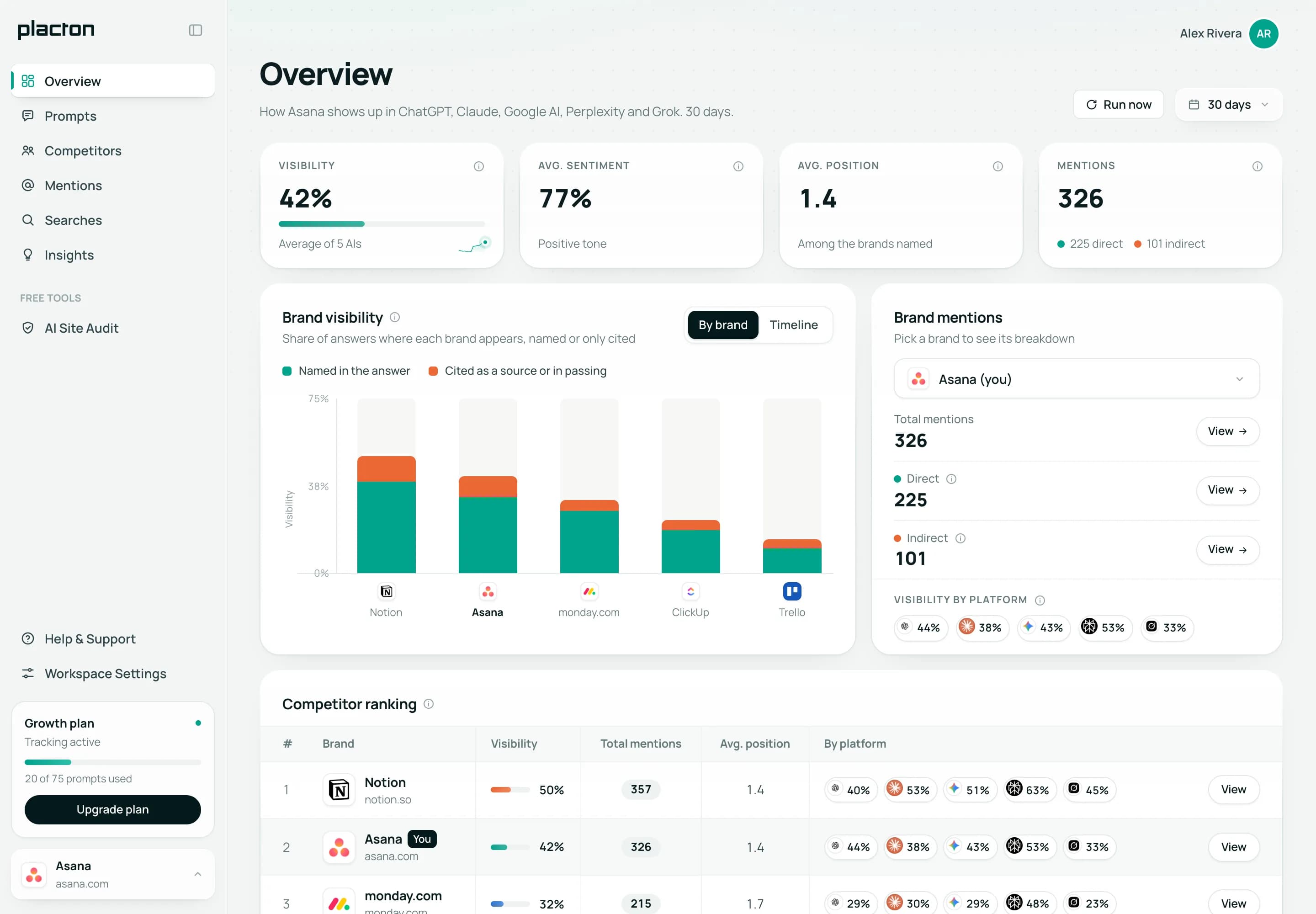
Placton dashboard: visibility, sentiment, average position and mentions, a chart of direct and indirect mentions by brand and the competitor ranking.

How Perplexity chooses the pages it cites

Perplexity is built around sources: it searches while it answers and shows the pages it used, numbered, next to its claims.

It searches as it answers

Each question sends Perplexity to the web, so what it cites depends on what it finds at that moment, and a page you improve can show up soon after it is crawled.

PerplexityBot decides if you can be found

Perplexity says PerplexityBot surfaces and links websites in its search results and is not used to train AI foundation models. Its advice is to allow it in robots.txt.

Perplexity-User reads on demand

When someone asks a question, Perplexity-User may fetch a page to answer it. Because a person asked, Perplexity says this fetcher generally ignores robots.txt.

Perplexity does not publish how it ranks one source above another. It does show every page it used, which makes it one of the easiest AI platforms to study: for each question, you can see exactly which pages you need to be on.

“best project management software for nonprofits”

PerplexityPerplexity·October 20
You're #3

For nonprofits, these tools are suggested most often:

  • Notion: docs, wikis and task lists in one place, handy for small teams.
  • monday.com: visual boards that volunteers pick up quickly.
  • Asana: clear owners and deadlines for programs and events.

Try two of them with a real program before you commit.

A Perplexity answer in Placton: named third, six sources cited and none of them yours (example data).

How to rank in Perplexity: 6 steps

No tricks and no promised positions: these steps make your pages easy for Perplexity to find, trust and quote.

  1. Let PerplexityBot through, at every layer

    Allow PerplexityBot in robots.txt. If a firewall or bot filter sits in front of your site, Perplexity recommends allowing its crawlers by user agent and by its published IP ranges, and keeping those ranges up to date. It says robots.txt changes can take up to 24 hours. Our free AI crawler checker tells you whether robots.txt lets it in.

  2. Read today’s sources for each question

    Ask the questions your buyers ask and write down every page Perplexity cites, whose it is and whether it names you. Because the sources are on screen, this takes minutes per question.

  3. Choose the pages to work on

    Not every cited page deserves the same effort. Start where a page is cited often and names your rivals but not you; the next section gives the order.

  4. Write passages that stand on their own

    Perplexity builds its answer from pieces of pages. Give each question its own section that answers it in the first sentence, with specific facts such as prices, sizes, dates or places, so the passage still makes sense when it is lifted out.

  5. Keep facts current and dated

    An answer built from live pages repeats what they say today, outdated prices included. Update the facts that change, and show a visible “updated” date when you do.

  6. Be present where Perplexity looks

    The review sites, comparison articles, forums and directories it cites for your topic can matter as much as your own site. Earn your place there: an accurate directory profile, a product sent to an independent reviewer, useful replies where your buyers already ask. To spot them across many questions, see AI citation tracking.

Which pages to improve first

Sort every page Perplexity cites for your questions into four groups, and work through them in this order.

  1. 01

    Third-party pages that name rivals, not you

    What it is
    A review, comparison or directory that Perplexity cites when it recommends your competitors.
    What to do
    Get listed, reviewed or quoted there. It is usually the shortest way into the answer.
    Where Placton shows it
    The weekly insight “Some sources recommend your competitors and not you”.
  2. 02

    Your pages that should be cited and are not

    What it is
    The page on your site that answers the question best, missing from the sources.
    What to do
    Put the answer in the first lines, add the specific facts and check that PerplexityBot can read it.
    Where Placton shows it
    Sources filtered by Perplexity, with your domain absent for that prompt.
  3. 03

    Your pages cited without your name

    What it is
    Perplexity uses your page as evidence, then recommends someone else or no one.
    What to do
    Make the brand and the fit explicit in the cited passage: who you are, what you offer and for whom.
    Where Placton shows it
    Indirect mentions in Mentions.
  4. 04

    Pages that already name you

    What it is
    Your own or third-party pages behind the answers that recommend you.
    What to do
    Keep their facts right and current. Little effort, a lot to lose.
    Where Placton shows it
    Sources, and the full answers in Searches.
Weekly insights in Placton that point to group 1 (example data).

See what AI can read on your website

We run 18 checks on what helps AI assistants find, read and cite your site, and tell you what to fix first.

Ready as soon as you sign up, included in the free trial.

No account? Free GEO audit tool: the same 18 checks, without signing up.

Perplexity vs ChatGPT: what changes in the sources

Both search the web and cite pages, but not in the same way, and Placton reads them differently too.

Scroll sideways to see every column.

How Perplexity and ChatGPT differ in searching, crawlers, citations and how Placton reads them, from their crawler documentation read October 24, 2026
What changesPerplexityChatGPT
When it searchesFor almost every question: searching is the core of the product.When it decides the question needs it. With search on, it often runs several searches for one question.
Crawler that lets you appearPerplexityBotOAI-SearchBot
Fetches a page when a user asksPerplexity-User, which generally ignores robots.txtChatGPT-User
Training crawlerNone listed: Perplexity says PerplexityBot is not used to train foundation modelsGPTBot, separate from search
How sources showNumbered citations next to the sentences they supportInline links and a list of sources
What Placton readsPerplexity’s API with its own live web search: the answer and every cited URLchatgpt.com, logged out with search on: the answer, every cited URL and the searches ChatGPT ran
How often in PlactonEvery week on paid plans; once, at sign-up, in the trialEvery day on paid plans*; in the trial, daily while you keep visiting

What it means for you. A page that both cite is the one to protect first. A page only Perplexity cites shows where its search looks and ChatGPT’s does not, and the other way round. In Placton, filter Sources by AI platform to compare the two lists.

The ChatGPT side of this table, step by step, is in our guide on how to rank in ChatGPT, and how Placton reads chatgpt.com is on the ChatGPT visibility tracker page.

* On paid plans. ChatGPT is read on chatgpt.com in every country Placton tracks except Venezuela and Puerto Rico, where it is asked weekly through its API.

How Placton measures Perplexity, and how often

What you get for Perplexity in Placton, including its limits.

  • Weekly, not daily. On paid plans Placton asks Perplexity every week, through its API with live web search. ChatGPT and Google AI Overviews are the daily ones.

  • Every cited URL. Each answer is stored in full with its sources, marked as yours, a competitor’s or a third party’s.

  • Perplexity on its own. Filter Mentions and Sources by Perplexity to read only its answers and the domains it leans on.

  • A flag when it lags. If Perplexity is your weakest AI platform by 25 points or more, your weekly insights say so.

  • One thing it does not record. The searches Perplexity ran before answering; Placton keeps those for ChatGPT.

See what Perplexity cites, free for 7 days

On the day you sign up, Perplexity and the other four AI platforms answer your prompts, so you see the sources behind each answer before you change a page.

  • 7 days free, no card. Sign up with your email or Google. When the trial ends, tracking stops and nothing is charged.

  • Up to 10 prompts. We suggest prompts and competitors from your website, and you edit the list before the first run.

  • All five AI platforms on day one. ChatGPT, Google AI Overviews, Claude, Perplexity and Grok answer your prompts as soon as your email is confirmed.

  • ChatGPT and Google AI again every day while you keep visiting your dashboard. Claude, Perplexity and Grok are asked once, at sign-up.

  • One “Run now” and the 18-point site audit. After the trial, our free GEO audit tool still audits any site, without an account.

  • On paid plans only: team invites and the weekly email summary with alerts.

* On paid plans. ChatGPT is read on chatgpt.com in every country Placton tracks except Venezuela and Puerto Rico, where it is asked weekly through its API.

Placton Starter

Track 20 prompts on 5 AI platforms

$59/ month (USD)

Or $602 billed yearly · save $106

Start your 7-day free trial

7 days free. No card required.

  • Up to 20 prompts, about 1,440 answers a month
  • ChatGPT, Google AI Overviews, Claude, Perplexity, Grok
  • ChatGPT and Google AI every day*, the other three every week
  • Competitor ranking (up to 25 rivals) and every cited URL
  • Weekly insights, plus an email summary with alerts
  • 18-point AI-readiness site audit
  • Up to 2 team members

Need more prompts? Growth is $129 a month for 75 and Scale $299 for 250. Compare all plans

Sources for this guide

What this guide says about Perplexity’s crawlers comes from Perplexity’s crawler documentation (opens in a new tab), and the ChatGPT column from the overview of OpenAI crawlers (opens in a new tab), both read on . The rest is practical advice: Perplexity does not publish how it ranks sources. We make Placton, so weigh our view accordingly.

Questions about ranking on Perplexity

About Placton itself? Read the full FAQs or see every plan and price.

How long does it take to rank on Perplexity?

Perplexity says robots.txt changes can take up to 24 hours. Because it searches as it answers, an improved page can be cited once its search finds it, sometimes within days. Answers still vary, so compare the same questions over a few weeks.

Does ranking on Google help you rank on Perplexity?

Indirectly. Perplexity runs its own search instead of showing Google’s results, but what helps a page rank, such as a clear answer, a crawlable page and links from sites people trust, also makes it easier for Perplexity to find and cite.

Should I block Perplexity-User?

Only if you do not want Perplexity to read your pages when people ask about them. Perplexity says this fetcher acts for a user and generally ignores robots.txt, so stopping it takes a firewall rule, and that also keeps answers from drawing on your page.

Why does Perplexity cite my page but not recommend me?

Perplexity used your page as evidence, for a fact or a definition, and then recommended the brands other sources put forward. Make that page state your offer and who it suits too, and look at which comparison pages favor your rivals. Placton logs these as indirect mentions, so you can see when they turn into direct ones.

How often does Placton check Perplexity?

Every week on paid plans, for every prompt, with Perplexity’s own live web search. It is not daily: ChatGPT and Google AI Overviews are the platforms Placton checks every day. In the free trial, Perplexity answers once, on the day you sign up.

Can anyone guarantee a ranking on Perplexity AI?

No. Perplexity picks its sources for every question, and no tool or agency controls that. What you can do is make your pages easy to find and to quote, and measure whether more answers cite and name you.

Is there a free way to see what Perplexity says about me?

Ask it your buyers’ questions yourself and note the sources. For a fuller picture, Placton’s 7-day trial needs no card and runs up to 10 prompts on Perplexity and the other four AI platforms on day one. Paid plans begin at $59 a month, and the 18-point site audit is free at any time on our GEO audit tool page, with no account.

See every plan and price

See which pages Perplexity cites for your topic

Add your website and the questions your buyers ask. On day one you see Perplexity’s sources next to those of ChatGPT, Google AI Overviews, Claude and Grok, and which of them name you.

Start your 7-day free trial

7 days free. No card required.

Compare all plans