GEO guide · Checked on October 19, 2026
Tools for monitoring GEO performance
Tools for monitoring GEO performance send the questions your buyers ask to AI assistants on a schedule and record whether your brand is named or cited, where and next to which rivals. Here is what to measure, how often, how to read it and which tools monitor ChatGPT, Google AI, Claude, Perplexity and Grok.
7 days free. No card required. Jump to the tool comparison
Placton tracks ChatGPT
 Claude
 Google AI
 Perplexity
 Grok

In short
- Track a fixed set of 20 to 100 prompts your buyers really ask, without your brand name in them.
- Core metrics: visibility, share of voice, average position, citation rate and tone, plus AI referral traffic.
- Answers change from run to run, so read 7-day trends and compare periods measured the same way.
- Free reports from Google, Bing and GA4 help, but none shows what ChatGPT, Claude or Perplexity say about you.
What GEO performance means
Here GEO stands for Generative Engine Optimization, not geography. GEO performance is how often, how prominently and how favorably AI assistants mention your brand when people ask about your category: “best payroll software for a small team”, “a good dentist in Austin”.
It is not SEO performance. In search you hold a position and count clicks. An AI answer has no fixed rank: the assistant writes a short reply with a few names and sources, and says something slightly different next time. Monitoring GEO means sampling those replies again and again and turning them into rates.
GEO metrics and KPIs: what to track and how to calculate each one
Every GEO monitoring tool starts from the same raw material: your prompts, each AI answer, and the brands and links inside it. These are the AI search metrics worth computing, and the AI visibility KPIs worth reporting.
Visibility (mention rate)
answers that include your brand ÷ valid answers × 100
The headline number. Answers without you count as zero. Work it out per AI, then average, so a daily engine does not drown out a weekly one.
Share of voice
your mentions ÷ mentions of all tracked brands × 100
How much of the conversation you hold against the rivals you chose. It moves when they gain or lose ground, even if your visibility is flat.
Average position
mean place of your brand in the answer, when named (1 = first)
Fifth in a list of seven is weaker than first. Average it only over answers that name you, and read it next to visibility.
Citation rate and citation share
answers linking to your site ÷ valid answers × 100
A link means the AI trusts your pages. Citation share (your citations ÷ all citations) shows how much of the source space you own.
Named versus cited
answers that name you, and answers that only cite your pages
Cited but not named means the AI uses your content without recommending you yet. That gap is often the quickest win.
Tone
positive, neutral or negative, per named mention
Watch for new negative mentions. The same critical answer repeated for seven days is one problem, not seven.
Source mix
cited domains split into yours, competitors and third parties
Shows which review sites, directories, forums and media the AI leans on. That is where outreach pays off.
AI referral traffic
sessions and conversions from AI assistants in GA4
The business result. It misses people who read an answer and search for you later, so treat it as a floor.
From GEO metrics to KPIs: the four to report
Track all of the metrics above, but report only a few, monthly, on 7-day averages and with the prompt set kept fixed between reports so each month compares with the last.
- 1
Visibility against your top three rivals. The headline GEO KPI. Report it next to theirs, on the same prompts and engines, as a four-week trend rather than a single figure.
- 2
Average position when named. Tells you whether AI recommends you first or adds you at the end of a list.
- 3
Citation rate of your own site. The share of answers that link to your pages: the part of GEO your content team controls most directly.
- 4
AI referral sessions and conversions. From GA4. The business result, and a floor, because many readers search for you later instead of clicking.
How often to measure, and why AI answers change
AI answers are not stable. AirOps found that only 30% of brands stay visible from one AI answer to the next, and just 20% across five runs in a row. Each time the model runs different searches and reads different pages, so a single check is one roll of the dice.
Daily or weekly?
Measure the engines your buyers use most every day and the rest at least weekly. Daily data is not for reacting daily: more answers make the weekly trend reliable sooner. Review weekly, report monthly, revisit prompts quarterly.
How many answers make a change real?
Visibility is a proportion, so ordinary sampling noise applies. Around 50% visibility, the 95% margin of error is roughly ±1/√n, where n is the number of answers in the period:
| Answers in the period | 95% margin of error at 50% visibility |
|---|---|
| 20 | ± 22 points |
| 50 | ± 14 points |
| 100 | ± 10 points |
| 300 | ± 6 points |
| 600 | ± 4 points |
Answers to the same prompt are correlated, so read these as best cases. A 5-point move on 50 answers is noise; a 10-point move that holds for two weeks across several engines is a change.
How to read your GEO data
Follow the line, not the dot.
Use a 7-day average per engine, then average the engines.
Compare like with like.
When a tool changes how it reads an engine (API to web interface, a new search provider or model), the numbers jump with nothing changing in your market. Compare only periods measured the same way.
Keep the prompt set fixed.
Ten easy new prompts lift visibility overnight. Let new prompts build history before they count.
Keep branded prompts out of the average.
“Is [your brand] any good?” names you almost every time. Track those prompts for tone, not visibility.
Benchmark against rivals, not a magic number.
There is no universal good score: 15% can lead a crowded software category while 60% trails in a niche with four players. What matters is your share against rivals in the same answers, and its direction.
What free reports cover, and what they miss
Three official sources added AI data in 2026. Connect them first.
| Source | What it shows | What it does not show |
|---|---|---|
| Google Search Console, Generative AI performance | Impressions in AI Overviews and AI Mode by page, country, date and device. Open to all sites since August 31, 2026. | Clicks, position, the answer itself and the other brands in it. |
| Bing Webmaster Tools, AI Performance | Citations of your pages in Copilot and Bing AI summaries, grounding queries and, since June 2026, citation share. | Clicks, and answers that name you without a link. |
| GA4, AI Assistant channel | Sessions from ChatGPT, Gemini, Copilot, Grok, DeepSeek and other assistants. | AI Overviews and AI Mode (they stay in Organic Search) and answers without a click. |
None shows unlinked mentions, your place in the list, tone, the competitors next to you, or what ChatGPT, Claude and Perplexity answer. That is the job of a monitoring tool.
How to set up GEO monitoring in six steps
- 1
Write 20 to 100 prompts the way buyers ask: problems, comparisons, “best X for Y”. Leave your brand out.
- 2
Choose engines by audience. ChatGPT and Google AI cover most research; add Perplexity, Claude or Grok when your buyers use them.
- 3
Add 3 to 10 real competitors, plus any brand that keeps showing up in the answers.
- 4
Collect two to four weeks of baseline before you change anything.
- 5
Log what you change (pages, PR, listings) and every model or source change, to tell cause from noise.
- 6
Connect the outcome: the GA4 AI Assistant channel for visits and Search Console for AI Overview impressions.
GEO performance monitoring tools compared
Checked on October 19, 2026on each vendor's official pages, for the entry plan. Only GEO performance tracking tools that measure AI answers are listed. After Placton, our product, the order is alphabetical, not a ranking. “Not stated” means we did not find it on the vendor's site. If budget is your main filter, see our best GEO tool under $100/month comparison.
Scroll sideways to see every column.
| Tool and entry plan | AI engines in the entry plan | Frequency | Where the answer comes from | Metrics reported | Source |
|---|---|---|---|---|---|
| PlactonOur productStarter $59/mo, 20 prompts | ChatGPT (on chatgpt.com), AI Overviews, Claude, Perplexity, Grok | ChatGPT and AI Overviews daily; the rest weekly | App for ChatGPT and AI Overviews; API with live web search for Claude, Perplexity and Grok | Direct and indirect mentions, position, tone, cited URLs, competitors | placton.tech/pricing |
| Ahrefs Brand RadarCustom prompts from $50/mo; also free with paid Ahrefs plans (5 prompts on Lite) | ChatGPT, AI Overviews, AI Mode, Gemini, Copilot, Perplexity; Claude costs 8 checks | Daily | App for its built-in prompt set; not stated for custom prompts (source) | Mentions, citations, share of voice, estimated impressions, competitors | ahrefs.com/brand-radar |
| AthenaHQStarter $295/mo, 3,600 answers; free plan: 300 credits on 5 models | 11 models, Claude and Grok included | Credit based | Not stated | Sentiment, citations, competitors; GA4 and Search Console | athenahq.ai/plans |
| GeoptieStarter $49/mo, 15 prompts, 2 brands | Any 4 of 7, Claude included; no Grok | Daily | Not stated | Citations, sentiment, competitors | geoptie.com/pricing |
| HubSpot AEO$50/mo, 25 prompts | ChatGPT, Gemini, Perplexity | Daily | Not stated | Visibility, sentiment, share of voice, citations | hubspot.com/products/aeo |
| LLM PulseStarter $58/mo, 50 prompts | ChatGPT, Perplexity, Gemini, AI Mode, AI Overviews; Claude and Grok extra | Weekly (daily at $94/mo) | Not stated | Visibility, share of voice, mentions, citations; sentiment from Growth; GA4 | llmpulse.ai/pricing |
| LLMrefsAll in One $79/mo, 500 prompts | ChatGPT, AI Overviews, AI Mode, Gemini, Perplexity, Claude, Copilot, Meta AI; Grok named only in its FAQ | Weekly | Not stated | Share of voice, position, citations, competitors | llmrefs.com/pricing |
| Otterly.AILite $29/mo, 15 prompts | ChatGPT, AI Overviews, Perplexity, Copilot; Claude extra | Daily | App (each AI’s website), except Claude through the API (source) | Visibility, sentiment, citations | otterly.ai/pricing |
| Peec AIStarter $95/mo, 50 prompts | Any 3 of ChatGPT, AI Mode, AI Overviews, Gemini, Copilot, Naver; Perplexity as a paid extra; Claude and Grok on Enterprise | Daily | App for most engines; labels its API models (Claude, Grok) (source) | Visibility, position, sentiment, sources, competitors; Google Analytics | peec.ai/pricing |
| ProfoundFree 7-day trial, then custom pricing | Trial: ChatGPT, Gemini, AI Overviews; 9 on Enterprise | Daily | App: captured in the browser, not through model APIs (source) | Share of voice, citations, sentiment, ranking, competitors; AI traffic | tryprofound.com/pricing |
| RankscalePro $99/mo, up to 4,800 answers | All main engines, Claude and Grok included | Hourly to monthly | Mixed: labels app engines (AI Overviews, Copilot) and API engines | Visibility, citations, sentiment, competitors | rankscale.ai/pricing |
| ScrunchCore $250/mo, 125 prompts, 5,000 answers | ChatGPT, Perplexity, AI Overviews, Copilot; Claude, Grok on Enterprise | Not stated | Mixed: browser automation or official APIs, by platform (source) | Citations, sentiment, competitors, AI bot traffic | scrunch.com/pricing |
| SE Visible (SE Ranking)Basic $99/mo, 200 prompts, ~30,000 answers | ChatGPT, Gemini, AI Mode, Perplexity, AI Overviews; Claude coming soon, no Grok | Daily | App: browser interface, not API | Mentions, position, sentiment, share of voice, citations | visible.seranking.com |
| Semrush AI VisibilityToolkit $99/mo per domain, 25 prompts | ChatGPT, Google AI Mode, Gemini | Daily | App, not API, for its prompt database; not stated for Prompt Tracking (source) | Visibility, mentions, position, sources, competitors | semrush.com/kb |
| WritesonicStarter $99/mo, 50 prompts | ChatGPT, Gemini, AI Overviews | Daily | Not stated | Competitors, Search Console; sentiment and GA4 on higher plans | writesonic.com/pricing |
Why GEO tool lists disagree
Most “best GEO tools” lists are written by the vendors themselves, and many mix tools that measure AI answers with tools that only optimize content. Plans also change fast (Profound no longer sells a $99 plan, and Peec AI's Starter, quoted at €89 in older lists, is now $95), so this table carries its check date and a source for every row.
Prompts, answers, credits and checks are different units
A prompt is a question; an answer is one reply from one engine; credits and checks are units of answers. Twenty prompts on two daily and three weekly engines make about 1,460 answers a month; fifty prompts on three daily engines, about 4,500. Compare coverage of the engines your buyers use, not the biggest number.
Interface or API: where the answer comes from
Some tools read the answer a person sees in the app; others query the API, which searches differently. SE Visible says it collects every answer through the browser interface, while Peec and Rankscale label their API engines; ask any vendor which you get. In our test of 47 real questions on October 19, 2026, a client's brand appeared in 8 ChatGPT answers through the API and in 19 on chatgpt.com.
See what AI can read on your website
We run 18 checks on what helps AI assistants find, read and cite your site, and tell you what to fix first.
Ready as soon as you sign up, included in the free trial.
No account? Free GEO audit tool: the same 18 checks, without signing up.
How Placton monitors GEO performance
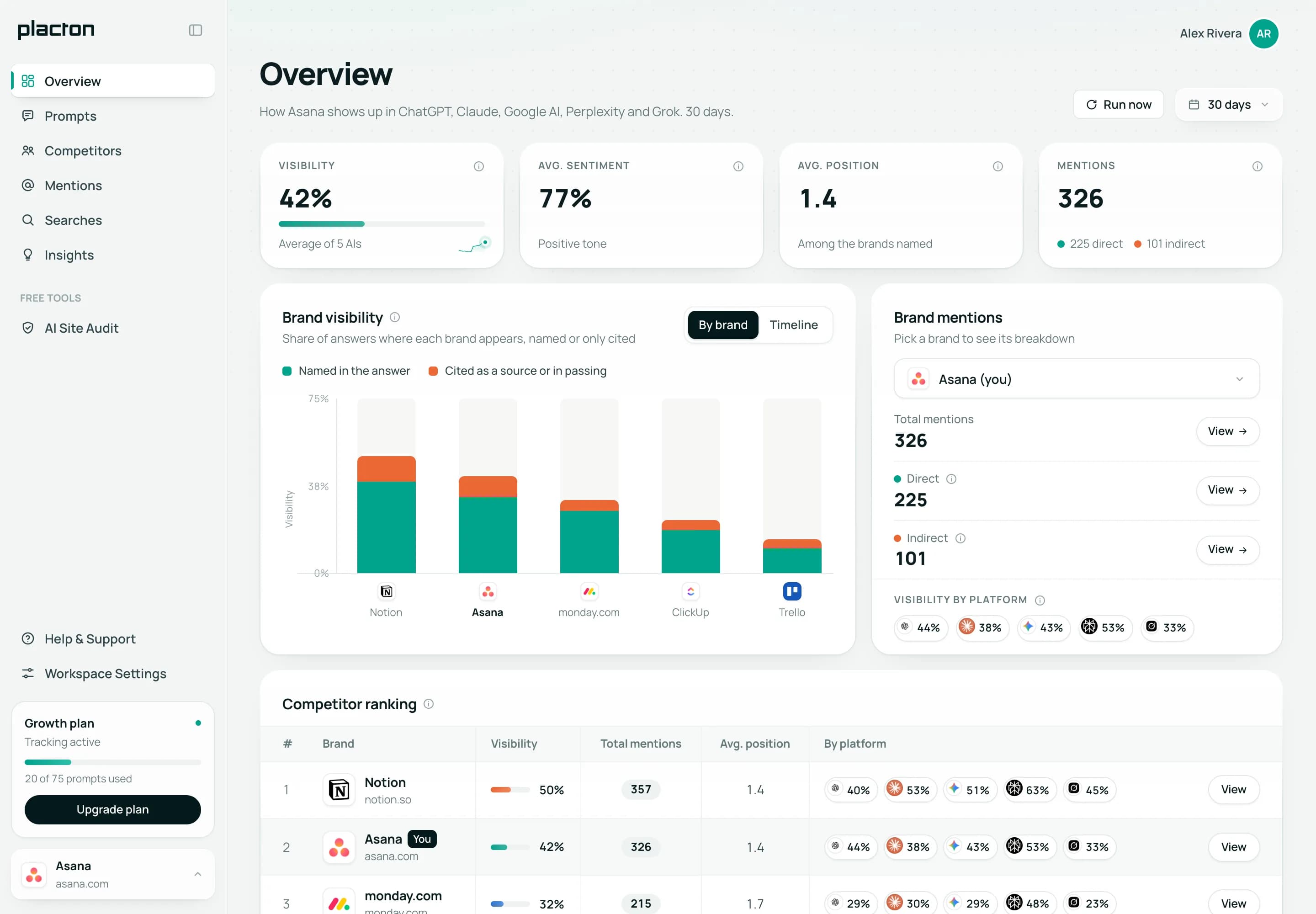
Placton is a GEO monitoring tool built around the method above. What it does today:
- Sends each prompt exactly as written, never adding your brand name or instructions that would bias the answer.
- On paid plans, reads ChatGPT on chatgpt.com, logged out and with web search on, and the real AI Overview in Google results, every day. Where chatgpt.com cannot be read (some countries and languages), ChatGPT goes through its API weekly.
- Asks Claude, Perplexity and Grok weekly through the API with live web search (Perplexity uses its own; Claude and Grok use a web search tool Placton connects).
- Counts answers without you as zero, weighs every AI equally and leaves an AI out of averages until it has 3 answers.
- Plots 7-day averages once there are two weeks of data, compares periods only with the same AIs and source, and marks source changes.
- Tracks direct and indirect mentions, position, tone, cited URLs and up to 25 competitors.
- On paid plans, a weekly email flags a 10-point drop, a competitor overtaking you or new negative answers.
- Adds weekly ideas from your numbers and an 18-point audit of your site.
Plans: $59 a month for 20 prompts, $129 for 75, $299 for 250; agencies pay $15 per client brand plus a prompt pool. All five AIs on every plan, and the 7-day trial needs no card. See pricing.
What the trial includes
Run the method above on your own prompts for 7 days before you pay anything.
7 days free, no card. Sign up with your email or Google. When the trial ends, tracking stops and nothing is charged.
Up to 10 prompts. We suggest prompts and competitors from your website, and you edit the list before the first run.
All five AI platforms on day one. ChatGPT, Google AI Overviews, Claude, Perplexity and Grok answer your prompts as soon as your email is confirmed.
ChatGPT and Google AI again every day while you keep visiting your dashboard. Claude, Perplexity and Grok are asked once, at sign-up.
One “Run now” and the 18-point site audit. After the trial, our free GEO audit tool still audits any site, without an account.
On paid plans only: team invites and the weekly email summary with alerts.
* On paid plans. ChatGPT is read on chatgpt.com in every country Placton tracks except Venezuela and Puerto Rico, where it is asked weekly through its API.
Placton Starter
Track 20 prompts on 5 AI platforms
$59/ month (USD)
Or $602 billed yearly · save $106
Start your 7-day free trial7 days free. No card required.
- Up to 20 prompts, about 1,440 answers a month
- ChatGPT, Google AI Overviews, Claude, Perplexity, Grok
- ChatGPT and Google AI every day*, the other three every week
- Competitor ranking (up to 25 rivals) and every cited URL
- Weekly insights, plus an email summary with alerts
- 18-point AI-readiness site audit
- Up to 2 team members
Need more prompts? Growth is $129 a month for 75 and Scale $299 for 250. Compare all plans
Questions about monitoring GEO performance
Questions about Placton itself? Read the full FAQs or go back to the home page.
How is GEO performance measured?
By asking AI assistants a fixed set of prompts on a schedule and turning the answers into rates: visibility, share of voice, average position, citation rate and tone.
What are the key KPIs for AI search visibility?
Visibility, share of voice, average position, citation rate and sentiment, plus AI referral sessions and conversions to tie them to revenue.
What does a GEO monitoring tool do?
It sends a fixed set of prompts to AI assistants on a schedule, stores every answer and turns them into GEO metrics: visibility, position, citations, tone and the rivals named next to you. A good one shows each answer in full, so you can check every number against the text behind it.
What are the best tools for measuring GEO performance?
The ones that cover the AI engines your buyers use, read them often enough to tell a trend from noise and show the answers behind each number. Start with the free reports from Google, Bing and GA4, then add a tracker for unlinked mentions, position and competitors. The comparison on this page shows what each one covers, with its source.
What is a good AI visibility score?
There is no universal benchmark. Judge it against competitors measured on the same prompts and engines, and by its direction over several weeks.
Is it possible to track brand mentions in ChatGPT?
Yes: ask fixed questions by hand in a clean session, several times each, or use a tool. Placton reads the answer shown on chatgpt.com every day on paid plans (in supported countries and languages).
How are GEO metrics different from SEO metrics?
SEO tracks positions and clicks on a results page. GEO tracks how often you are named or cited inside generated answers, where and with what tone.
Which free reports show GEO performance?
Search Console (AI Overview and AI Mode impressions), Bing Webmaster Tools (Copilot citations) and GA4 (visits from AI assistants). None shows unlinked mentions, position, tone or competitors. Placton has a 7-day free trial with no card.
Do GEO performance tracking tools show traffic from AI?
Most measure what the answers say, not the visits they send. Visits from AI assistants are in GA4 and AI Overview impressions in Search Console, both free. Some vendors list AI traffic among their metrics; the comparison table shows what each one reports.
How many prompts should I track?
Start with 20 to 50 prompts that cover your main products and buying questions, and grow once the list is stable. A short list measured often beats a long one checked once.
How often should I check GEO performance?
Collect daily on your main engines and weekly on the rest, review weekly and report monthly. Reacting to one day of answers means reacting to noise.
Start monitoring your GEO performance
Add your website, keep the prompts your buyers ask and read on day one what ChatGPT, Google AI Overviews, Claude, Perplexity and Grok say about you.
7 days free. No card required.